 Daniel Okoye
A driver’s license is an official document issued by the Federal Government of Nigeria that authorizes an individual to drive legally on public roads. It confirms that the holder has been trained, tested, and certified competent to operate a specific category of vehicle.
In Nigeria, driver’s licenses are issued under the supervision of the Federal Road Safety Corps (FRSC), in collaboration with State Boards of Internal Revenue and Driver’s License Centers (DLCs).
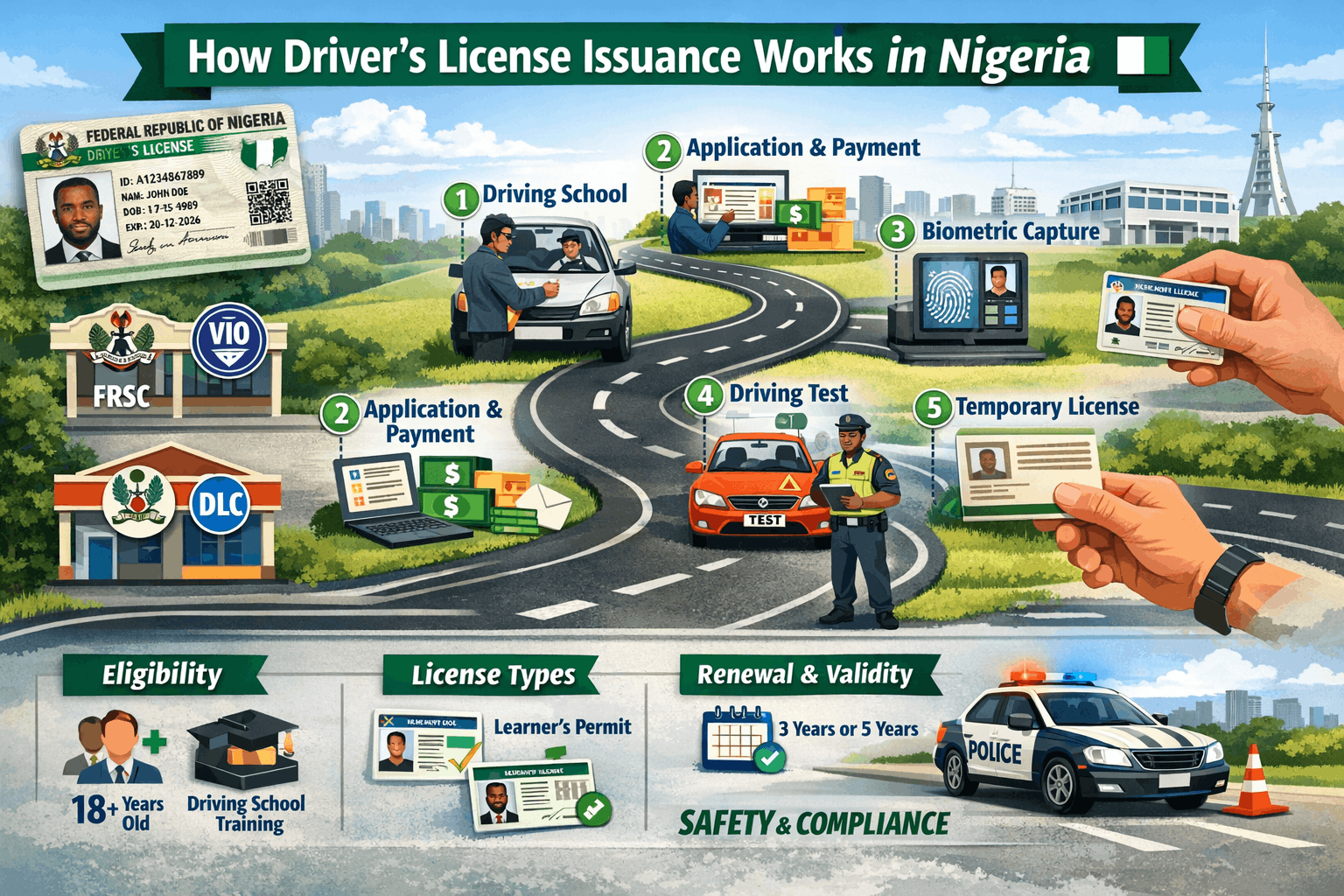
This article explains how driver’s license issuance works in Nigeria, including eligibility, requirements, application steps, testing, renewal, and key facts every driver should know.
What Is a Driver’s License?
A Nigerian driver’s license is a government-issued card that confirms a person’s legal authority to drive. It contains:
-
Full name
-
Photograph
-
Date of birth
-
License number
-
Approved vehicle class
-
Issue date
-
Expiry date
-
Issuing authority
Beyond driving authorization, it also serves as a valid form of identification nationwide.
Authorities Responsible for Issuing Driver’s Licenses
Several agencies work together in the issuance process:
-
Federal Road Safety Corps – Supervises and maintains the National Driver’s License database
-
State Boards of Internal Revenue (BIR) – Handle payments and administrative processing
-
Driver’s License Centers (DLCs) – Capture biometric data and process applications
-
Vehicle Inspection Office (VIO) – Conduct driving tests in many states
-
Accredited Driving Schools – Train applicants
The FRSC ensures the system is standardized across Nigeria.
Types of Driver’s Licenses in Nigeria
There are two major types:
Learner’s Permit
This is issued to individuals learning to drive.
-
Used only for training
-
Requires supervision by a licensed driver
-
Typically arranged through accredited driving schools
Permanent Driver’s License
Issued after completing training and passing required tests.
-
Allows independent driving
-
Issued in a secure plastic card format
Vehicle Classes Covered by Nigerian Driver’s License
Driver’s licenses are issued according to vehicle class.
Common classes include:
-
Class A – Motorcycle
-
Class B – Motor vehicles less than 3 tons
-
Class C – Private cars
-
Class D – Commercial vehicles
-
Class E – Heavy-duty vehicles
-
Class F – Agricultural vehicles
Applicants must select the correct class during application.
Eligibility Requirements
To qualify for a driver’s license in Nigeria, you must:
-
Be at least 18 years old
-
Be medically fit
-
Attend an accredited driving school
-
Pass the driving test
-
Provide valid identification
These requirements ensure only competent drivers are licensed.
Documents Required
Applicants must provide:
-
National Identification Number (NIN)
-
Birth certificate or age declaration
-
Passport photographs
-
Driving school certificate
-
Completed application form
-
Proof of payment
These documents verify identity and eligibility.
Step-by-Step Process of Getting a Driver’s License
Step 1: Attend an Accredited Driving School
The first step is enrolling in a government-approved driving school.
Training includes:
-
Road signs and traffic rules
-
Defensive driving techniques
-
Practical driving lessons
After completion, you receive a certificate.
Step 2: Submit Application
You can apply online through the National Driver’s License portal or at a Driver’s License Center.
The application process includes:
-
Filling out personal details
-
Selecting vehicle class
-
Submitting required information
Step 3: Make Payment
Applicants must pay official government fees.
Payment typically covers:
-
Processing fee
-
Biometric capture
-
License production
Payments are made through designated banks or approved platforms.
Step 4: Biometric Capture
At the Driver’s License Center, officials capture:
-
Fingerprints
-
Photograph
-
Digital signature
This data is stored in the national database.
Step 5: Take Driving Test
The driving test is conducted by the Vehicle Inspection Office (VIO) or authorized officials.
The test evaluates:
-
Practical driving ability
-
Knowledge of traffic rules
-
Understanding of road signs
Passing the test confirms competence.
Step 6: Issuance of Temporary License
After successful testing and biometric capture, a temporary driver’s license is issued.
-
Valid for 60 days
-
Allows legal driving while waiting for permanent card
Step 7: Collection of Permanent License
The permanent plastic license is produced and sent to the Driver’s License Center.
Applicants are notified when it is ready for collection.
Licenses are issued with:
-
3-year validity, or
-
5-year validity
depending on the option selected.
Validity Period
Driver’s licenses in Nigeria have expiration dates.
Options include:
-
3-year license
-
5-year license
Driving with an expired license is an offense.
Driver’s License Renewal
When a license expires, renewal is required.
Steps include:
-
Applying online or at a DLC
-
Completing renewal form
-
Paying renewal fee
-
Biometric verification if necessary
-
Collecting renewed license
Renewal keeps driver records updated.
Cost of Driver’s License
Fees vary based on validity period.
-
3-year license costs less
-
5-year license costs more
Additional expenses may include:
-
Driving school fees
-
Medical certification
Government-approved fees are standardized nationwide.
Importance of Having a Valid Driver’s License
A valid driver’s license is important because it:
-
Authorizes legal driving
-
Serves as official identification
-
Is required for employment as a driver
-
Is needed for insurance processing
-
Helps law enforcement verify identity
It promotes accountability and road safety.
Penalties for Driving Without a License
Driving without a valid license is illegal.
Penalties may include:
-
Fines
-
Vehicle impoundment
-
Court prosecution
-
Driving disqualification
These penalties support enforcement of traffic laws.
Security Features of Modern Driver’s Licenses
Modern Nigerian driver’s licenses include:
-
Embedded chip
-
Unique identification number
-
Biometric data
-
Tamper-resistant material
These features reduce fraud and duplication.
Role of the National Driver’s License Database
Nigeria maintains a centralized driver database managed by the Federal Road Safety Corps.
The database helps:
-
Prevent multiple licenses
-
Track driver records
-
Verify identity
-
Support law enforcement
It improves transparency and road safety management.
Common Mistakes to Avoid
Applicants should avoid:
-
Providing incorrect personal details
-
Using unaccredited driving schools
-
Skipping the driving test
-
Losing temporary license
-
Failing to collect permanent card
Following the correct procedure ensures smooth processing.
Temporary vs Permanent License
Temporary License:
-
Issued immediately after processing
-
Paper format
-
Valid for short period
Permanent License:
-
Plastic card format
-
Long-term validity
-
More secure
Both are legally recognized within their validity period.
Conclusion
Driver’s license issuance in Nigeria follows a structured process designed to ensure that only qualified individuals are permitted to drive. It involves attending an accredited driving school, applying through approved centers, completing biometric capture, passing a driving test, and receiving a permanent license.
The Federal Road Safety Corps oversees the system to maintain national standards and improve road safety.
Having a valid driver’s license is not just a legal requirement—it is a responsibility that promotes safe driving, accountability, and proper identification. Anyone intending to drive in Nigeria must follow the proper procedures to obtain and maintain a valid license.

Daniel Okoye
Daniel Okoye is a writer and researcher at ProcesslyHub. I focus on explaining Nigerian systems, housing processes, and everyday business workflows in simple and practical terms. My goal is to help readers understand how real-world processes work so they can make informed decisions and avoid costly mistakes.
 Daniel Okoye