 Daniel Okoye
Building approval is one of the most important steps in property development in Nigeria, yet it is also one of the most misunderstood. Many people assume approval is just a formality, while others avoid it completely because they believe it is too complex or unnecessary. In reality, building approval exists to ensure safety, proper planning, and legal compliance, and ignoring it can lead to serious consequences.
This article explains how building approval processes work in Nigeria, what is required, who is involved, and what most people are not told.
What Building Approval Means
Building approval is the official permission given by the appropriate government authority allowing a property owner or developer to construct, renovate, or modify a building on a particular piece of land.
Approval confirms that:
-
The land is suitable for the proposed building
-
The design meets planning and safety standards
-
The building aligns with zoning and land-use regulations
Without approval, a building is considered illegal, regardless of how much money was spent on it.
Why Building Approval Is Required
Building approval is not just about government revenue. It serves several important purposes.
First, it helps ensure structural safety. Approved drawings are reviewed by professionals to confirm that the building will not collapse or endanger lives.
Second, it supports proper urban planning. Approval helps prevent buildings from blocking drainage channels, roads, power lines, or neighboring properties.
Third, it protects the property owner. A building with approval is easier to insure, sell, lease, or use as collateral.
Finally, approval reduces disputes. Many building conflicts arise because a structure was built without permission or outside approved boundaries.
Authorities Responsible for Building Approval
Building approvals in Nigeria are handled at different levels depending on the location of the property.
In most cases, approval is issued by:
-
State physical planning or urban development authorities
-
Local government planning offices for smaller residential projects
-
Development control departments in urban areas
Each state has its own agency, but the process and requirements are generally similar across the country.
Types of Building Approvals
There is no single approval for all buildings. The type of approval required depends on what you want to build.
Common types include:
-
Residential building approval
-
Commercial building approval
-
Renovation or remodeling approval
-
Change-of-use approval
-
Extension or additional floor approval
If you change the purpose of a building, such as converting a residential property to commercial use, a fresh approval is usually required.
Documents Required for Building Approval
Before approval can be granted, certain documents must be submitted. These documents help authorities verify ownership, design accuracy, and compliance.
Common requirements include:
-
Survey plan of the land
-
Proof of land ownership
-
Architectural drawings
-
Structural drawings
-
Mechanical and electrical drawings
-
Site analysis report
-
Tax clearance or development levy receipts
-
Application forms
All drawings are expected to be prepared and endorsed by registered professionals.
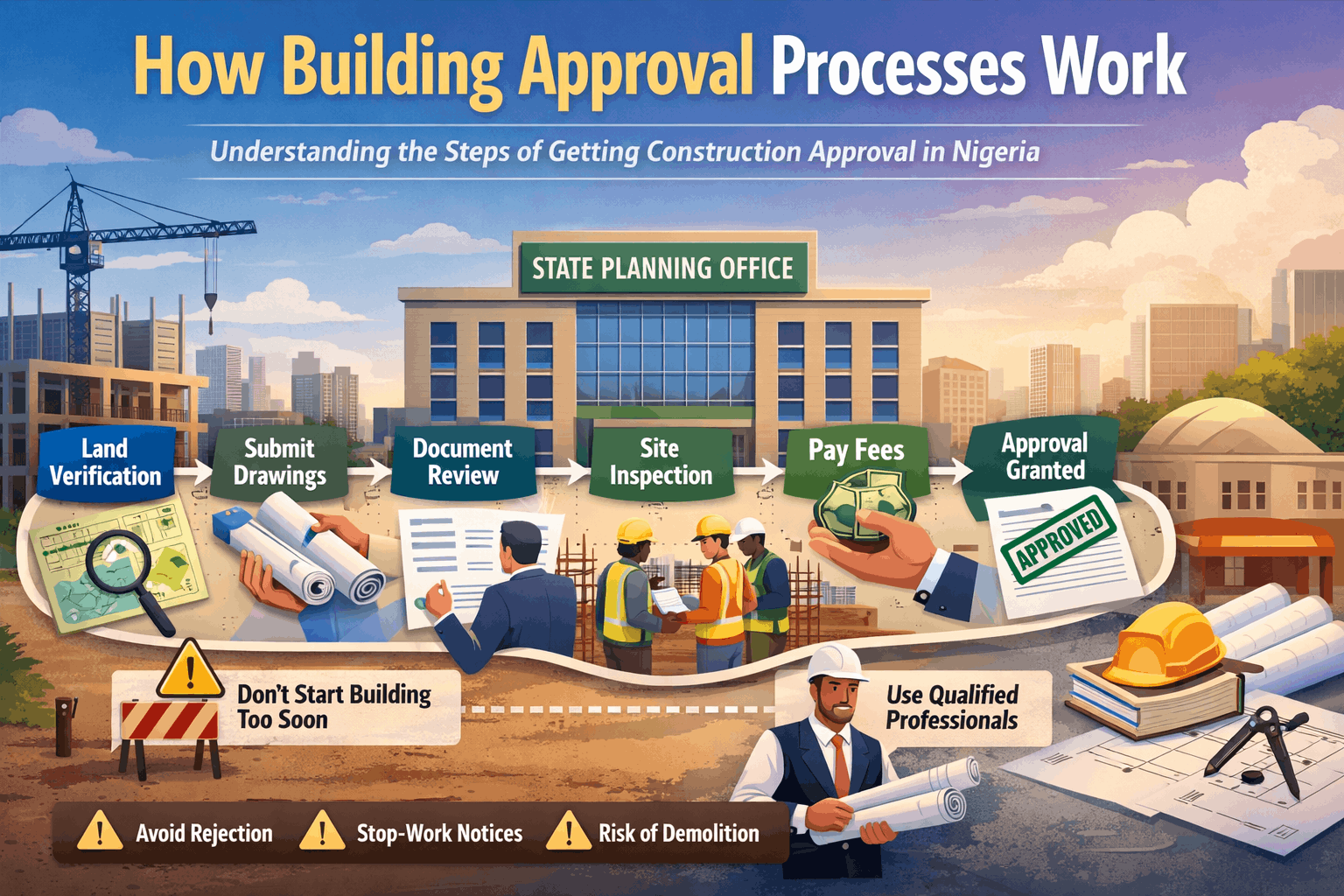
Step-by-Step Building Approval Process
Although the process may vary slightly by state, it usually follows a clear sequence.
The first step is land verification. Authorities confirm that the land is in an approved zone and not under government acquisition or restriction.
Next is submission of drawings and documents. The applicant or consultant submits architectural, structural, and service drawings along with required documents.
After submission, technical review begins. Professionals within the planning authority examine the drawings to ensure they meet safety, zoning, and planning standards.
Site inspection usually follows. Officials visit the land to confirm boundaries, setbacks, access roads, and alignment with submitted drawings.
If everything is satisfactory, approval fees are calculated and paid. These fees vary depending on location, building size, and type of development.
Once payment is confirmed, the approval letter or permit is issued, authorizing construction to begin.
Timeline for Building Approval
Many people expect approval to be instant, but it is rarely so.
Approval timelines depend on:
-
The state or local authority
-
Completeness of documents
-
Type of building
-
Responsiveness to corrections
For residential buildings, approval may take a few weeks to several months. Delays often happen when documents are incomplete or drawings do not meet standards.
Common Mistakes People Make
One common mistake is starting construction before approval is granted. Some people submit applications and begin building immediately, assuming approval will come later. This can lead to stop-work notices or demolition.
Another mistake is using unqualified draftsmen instead of registered professionals. Poor drawings often lead to rejection or repeated corrections.
Some people also submit incorrect or fake documents, especially survey plans. Once discovered, the entire application may be cancelled.
Ignoring zoning laws is another major issue. Not all lands are approved for all types of buildings, regardless of ownership.
What Most People Are Not Told
Many developers are not told that approval is not permanent. Approval is tied to specific drawings. Any major change to the design requires fresh approval.
Another overlooked fact is that approval does not replace other permits. Environmental, fire safety, and occupancy permits may still be required.
Also, approval does not protect against community disputes. Local consent and peaceful possession still matter, especially in traditional areas.
Finally, approval does not mean construction can be careless. Authorities can still inspect and enforce compliance during construction.
Consequences of Building Without Approval
Building without approval carries serious risks.
Authorities can issue stop-work notices at any stage of construction. In severe cases, buildings may be sealed or demolished.
Unapproved buildings are difficult to sell or transfer legally. Financial institutions usually reject such properties for loans.
Insurance claims may be denied if a building lacks approval. Legal disputes become harder to resolve without official permits.
In the long run, the cost of fixing approval issues is often higher than doing it properly from the start.
Final Thoughts
Building approval is not an obstacle; it is a protective process designed to ensure safety, order, and legal security. While the process may seem stressful or slow, understanding how it works makes it easier to navigate.
For anyone planning to build in Nigeria, securing proper approval should be treated as a priority, not an afterthought. It protects your investment, your future plans, and the people who will use the building.
Understanding the process is the first step toward building with confidence and peace of mind.

 Daniel Okoye