 Daniel Okoye
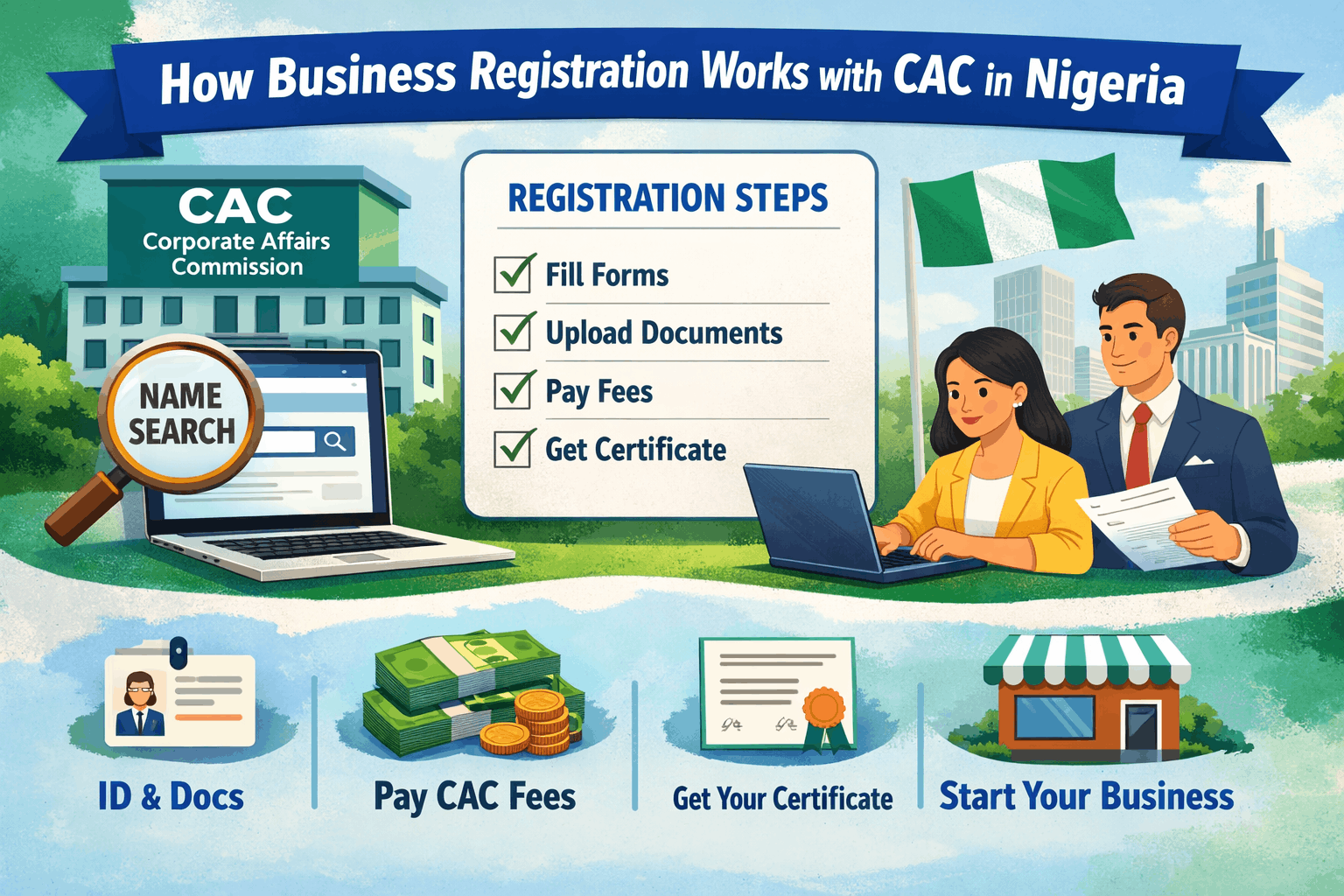
Registering a business in Nigeria is one of the first formal steps toward operating legally and building credibility. The body responsible for this process is the Corporate Affairs Commission (CAC). Understanding how business registration works with CAC helps entrepreneurs avoid mistakes, delays, and unnecessary costs.
This article explains the process in clear terms, from choosing a business type to receiving your registration documents.
What Is CAC and Why It Matters
The Corporate Affairs Commission (CAC) is the Nigerian government agency responsible for registering and regulating businesses, companies, and incorporated trustees. Once your business is registered with CAC, it becomes legally recognized by the government.
CAC registration is important because it:
-
Gives your business legal identity
-
Allows you to open a corporate bank account
-
Builds trust with customers and partners
-
Makes it easier to access loans, grants, and contracts
-
Protects your business name from being used by others
Without CAC registration, a business is considered informal and may face limitations.
Types of Business You Can Register with CAC
Before starting the process, you must decide the type of business structure that suits your operation.
Business Name (Sole Proprietorship or Partnership)
This is the most common option for small businesses.
-
Owned by one person or two or more partners
-
Easy and affordable to register
-
Suitable for traders, freelancers, artisans, consultants, and small startups
Private Limited Company (Ltd)
This option is suitable for growing or corporate businesses.
-
Separate legal entity from its owners
-
Requires at least two directors
-
More credibility and structure
-
Higher registration cost and documentation
Incorporated Trustees
This is used for:
-
NGOs
-
Churches and mosques
-
Associations and foundations
The registration process is different and usually takes longer.
Step 1: Decide Your Business Name
The first practical step is choosing a business name. The name must:
-
Be unique
-
Not be misleading
-
Not conflict with existing registered names
-
Not contain restricted words unless approval is obtained
It is advisable to prepare two name options in case one is unavailable.
Step 2: Name Availability Search and Reservation
CAC requires you to check if your proposed business name is available. This is done on the CAC online portal.
If the name is available, you can reserve it. Once approved:
-
The name is reserved for you
-
You have a limited time to complete registration
If the name is not available, CAC will reject it and ask you to choose another.
Step 3: Create a CAC Account and Fill Registration Details
After name approval, you proceed to register by filling the required details online.
You will be asked to provide:
-
Business name
-
Nature of business
-
Business address
-
Owner’s or directors’ details
-
Date of commencement
For companies, additional details such as share structure and directors’ information are required.
Accuracy is very important at this stage, as errors can delay approval.
Step 4: Upload Required Documents
CAC requires specific documents depending on the type of business.
For Business Name Registration
-
Valid means of identification (NIN, international passport, driver’s license, or voter’s card)
-
Passport photograph
-
Signature
For Limited Companies
-
Means of identification for directors and shareholders
-
Memorandum and Articles of Association
-
Statement of share capital
-
Registered address
All documents are uploaded online through the CAC portal.
Step 5: Pay CAC Registration Fees
After completing the form and uploading documents, you will be required to pay the registration fee.
The cost depends on:
-
Type of business
-
Share capital (for companies)
Payments are made online through the CAC platform. Once payment is confirmed, your application is submitted for review.
Step 6: CAC Review and Approval
CAC officials review the submitted information and documents. During this stage:
-
They may approve the application
-
They may request corrections
-
They may reject it if requirements are not met
Approval time varies. Some registrations are approved within a few days, while others may take longer depending on accuracy and workload.
Step 7: Download Your CAC Certificate and Documents
Once approved, you can download:
-
Certificate of Registration
-
Status report
-
Approved documents
These documents serve as official proof that your business is registered with CAC.
You can print them or keep digital copies for official use.
Common Mistakes People Make During CAC Registration
Many delays happen because of avoidable errors.
Common mistakes include:
-
Choosing a name that violates CAC rules
-
Entering incorrect personal details
-
Using inconsistent addresses
-
Uploading unclear documents
-
Registering the wrong business type
Understanding the process before starting helps reduce these problems.
Can You Register a Business Without an Agent?
Yes, CAC registration can be done personally online without an agent. However:
-
Some people prefer agents due to unfamiliarity with the process
-
Agents help reduce errors but charge service fees
Whether you use an agent or not, it is important to understand what is being done on your behalf.
What CAC Registration Does Not Automatically Give You
Registering with CAC does not automatically mean:
-
You are registered for tax
-
You have business permits for regulated sectors
-
You are registered with regulatory bodies
Additional registrations may be required depending on your business type.
Final Thoughts
Understanding how business registration works with CAC helps entrepreneurs start on the right legal foundation. The process is now largely digital, structured, and accessible, but accuracy and proper knowledge are key.
Registering your business is not just a formality; it is a step toward legitimacy, growth, and long-term sustainability in Nigeria’s business environment.
By knowing each stage of the process, you can register confidently, avoid mistakes, and focus on building your business.


 Daniel Okoye