 Daniel Okoye
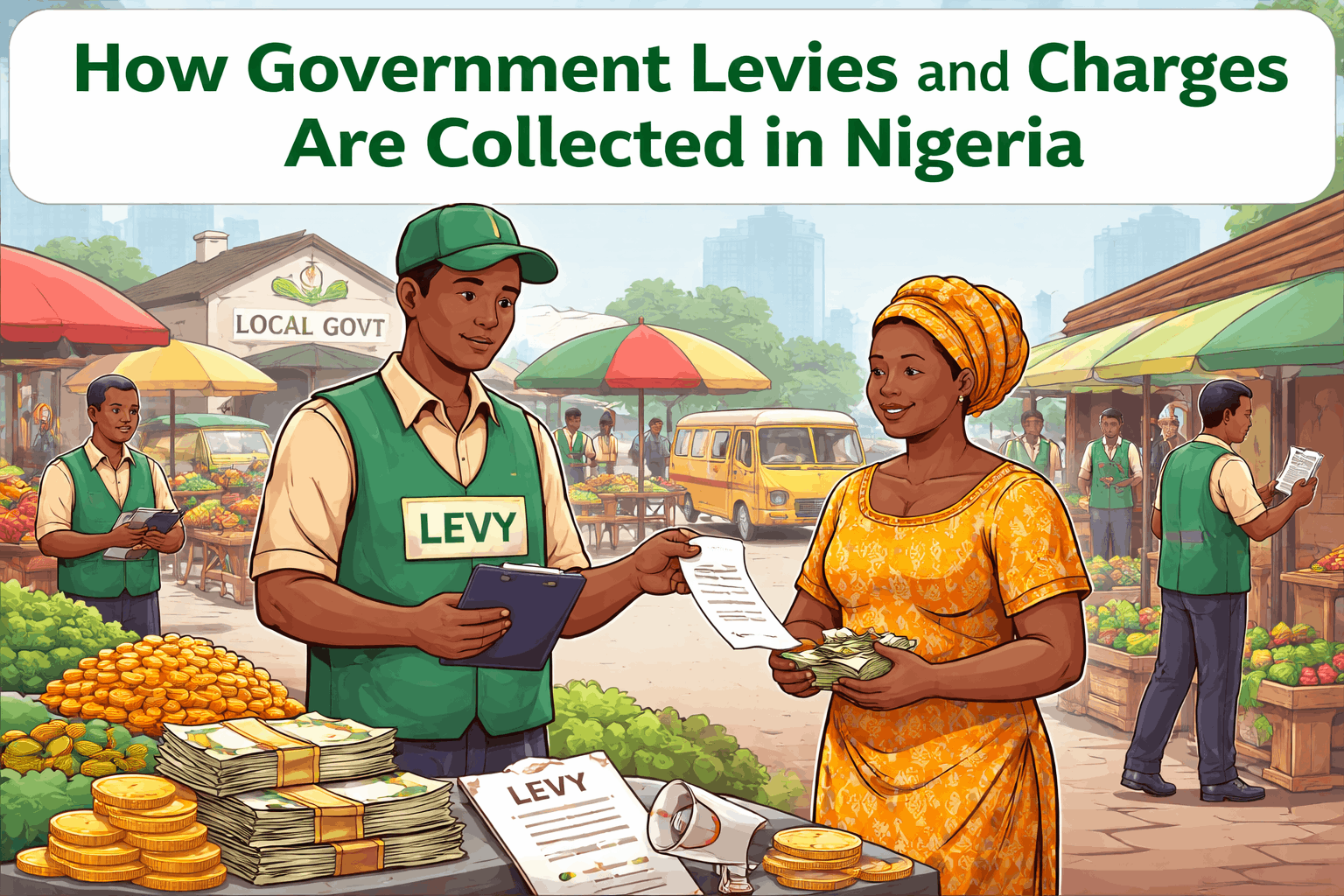
Government levies and charges are part of everyday life in Nigeria. Traders in markets, shop owners, transport operators, landlords, and small business owners encounter them regularly. Yet many people pay these levies without fully understanding who is collecting them, the legal basis behind them, and how the money is supposed to be used.
This article explains how government levies and charges are structured and collected in Nigeria, using practical examples and simple language.
What Are Government Levies and Charges?
Government levies and charges are compulsory payments imposed by legally recognized authorities to fund public services and administration.
They are different from fines. A fine is a punishment for breaking a law. A levy, on the other hand, is a required payment connected to:
-
Running a business
-
Owning or using property
-
Operating a vehicle
-
Using public infrastructure
-
Displaying signage or advertisements
Depending on the type of levy and the level of government involved, payments may be required daily, weekly, monthly, or annually.
The Three Levels of Government and Their Roles
Nigeria operates a three-tier system of government:
-
Federal Government
-
State Government
-
Local Government
Each level has specific authority to collect certain taxes and levies.
Federal Government
The federal government mainly handles nationwide taxes and regulatory charges. These include company income tax, customs duties, and some national licensing fees.
These are administered through agencies such as the Federal Inland Revenue Service (FIRS), which is responsible for assessing and collecting federal taxes.
State Government
State governments collect taxes and levies within their states. These may include:
-
Personal income tax (for residents)
-
Business premises levies
-
Development levies
-
Road taxes and vehicle licensing fees
Each state operates its own Internal Revenue Service, such as the Lagos State Internal Revenue Service (LIRS).
Local Government
Local governments collect the most visible levies affecting daily life. These include:
-
Market levies
-
Shop permits
-
Motor park fees
-
Signage and advertisement fees
-
Environmental and sanitation levies
Many of the levies people encounter in markets and motor parks fall under local government authority.
Who Actually Collects the Money?
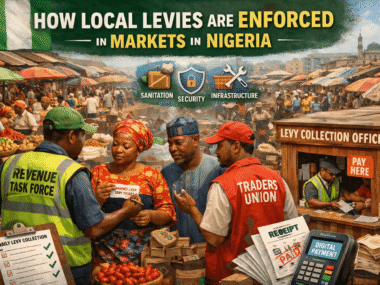
Although laws assign levy collection to government institutions, the individuals who physically collect payments may differ.
In formal systems, trained staff of revenue agencies collect payments using:
-
Official receipts
-
Bank payment slips
-
POS machines
-
Government-approved online portals
In semi-formal or informal settings, especially at the local government level, collection may be carried out by:
-
Revenue collectors
-
Task force members
-
Licensed agents
In some cases, governments appoint private consultants to collect certain levies on their behalf. This arrangement is legal when properly documented, but it can create confusion if collectors fail to identify themselves clearly.
Step-by-Step: How Levy Collection Typically Works
Although levy collection may appear unstructured in some places, it usually follows a process.
First, the government authority identifies the category of people required to pay. This may include traders in a specific market, shop owners in a district, or transport operators in a motor park.
Next, a demand notice or announcement is issued. In formal settings, this is often written. In informal settings, collectors may notify individuals verbally.
Payment is then made. Depending on the system, payment may be in cash, via bank transfer, POS, or through an online portal. Ideally, every payment should come with a receipt that clearly states:
-
The type of levy
-
The amount paid
-
The issuing authority
Finally, the money collected is remitted to the appropriate government account, usually on a daily or periodic basis.
Common Levies Nigerians Encounter
Some of the most common levies include:
Market levies, paid daily or weekly by traders for stall space, sanitation, and security.
Business premises levies, charged to shops and offices operating within a local or state area.
Motor park and transport levies, often collected daily from commercial drivers.
Signage and advertisement levies, charged for displaying banners, shop signs, or billboards.
Environmental and development levies, meant to support waste management and local infrastructure.
Why Confusion and Conflict Often Occur
Conflicts around levy collection usually arise from lack of clarity and transparency.
Some common issues include:
-
Multiple collectors demanding payment for similar levies
-
Lack of clear explanation about what the levy is for
-
Inconsistent or changing rates
-
Absence of visible improvements in public services
When people do not see improvements in roads, sanitation, or security, they may question why levies are being collected.
In some cases, unauthorized individuals pose as revenue collectors, leading to harassment or exploitation.
How to Identify Legitimate Government Levies
Not every demand for money is lawful. There are basic signs of legitimate levy collection.
Legitimate collectors should:
-
Clearly identify the government authority they represent
-
Provide official identification
-
Issue printed or traceable receipts
-
State clearly what the levy covers
Official levies typically have fixed rates rather than random figures that change without explanation.
When unsure, individuals and business owners can confirm details with their local government secretariat or state revenue office.
What Happens to the Money Collected?
In theory, government levies are intended to fund public services such as:
-
Market maintenance
-
Waste disposal
-
Road repairs
-
Public security
-
Administrative operations
However, the effectiveness of this system depends on transparency, monitoring, and accountability. Where oversight is weak, public trust in levy collection decreases.
The gap between collection and visible public impact is one of the reasons many Nigerians question levy systems.
What Many People Do Not Realize
Many levies have legal backing in state laws or local government bye-laws, even if they are poorly communicated.
At the same time, some collections continue simply because people comply without verifying whether they are properly authorized.
Understanding the structure of levy collection helps individuals know when to comply, when to request clarification, and when to seek confirmation from official sources.
Conclusion
Government levies and charges in Nigeria are collected through a combination of formal institutional systems and on-the-ground processes at federal, state, and local levels.
While the intention is to fund public services, lack of transparency and communication often leads to confusion and conflict.
By understanding who is authorized to collect levies, how payments should be made, and what documentation to request, Nigerians can protect themselves from exploitation and engage more confidently with the system. Knowledge of how the process works is an important step toward fairness and accountability.


 Daniel Okoye