 Daniel Okoye
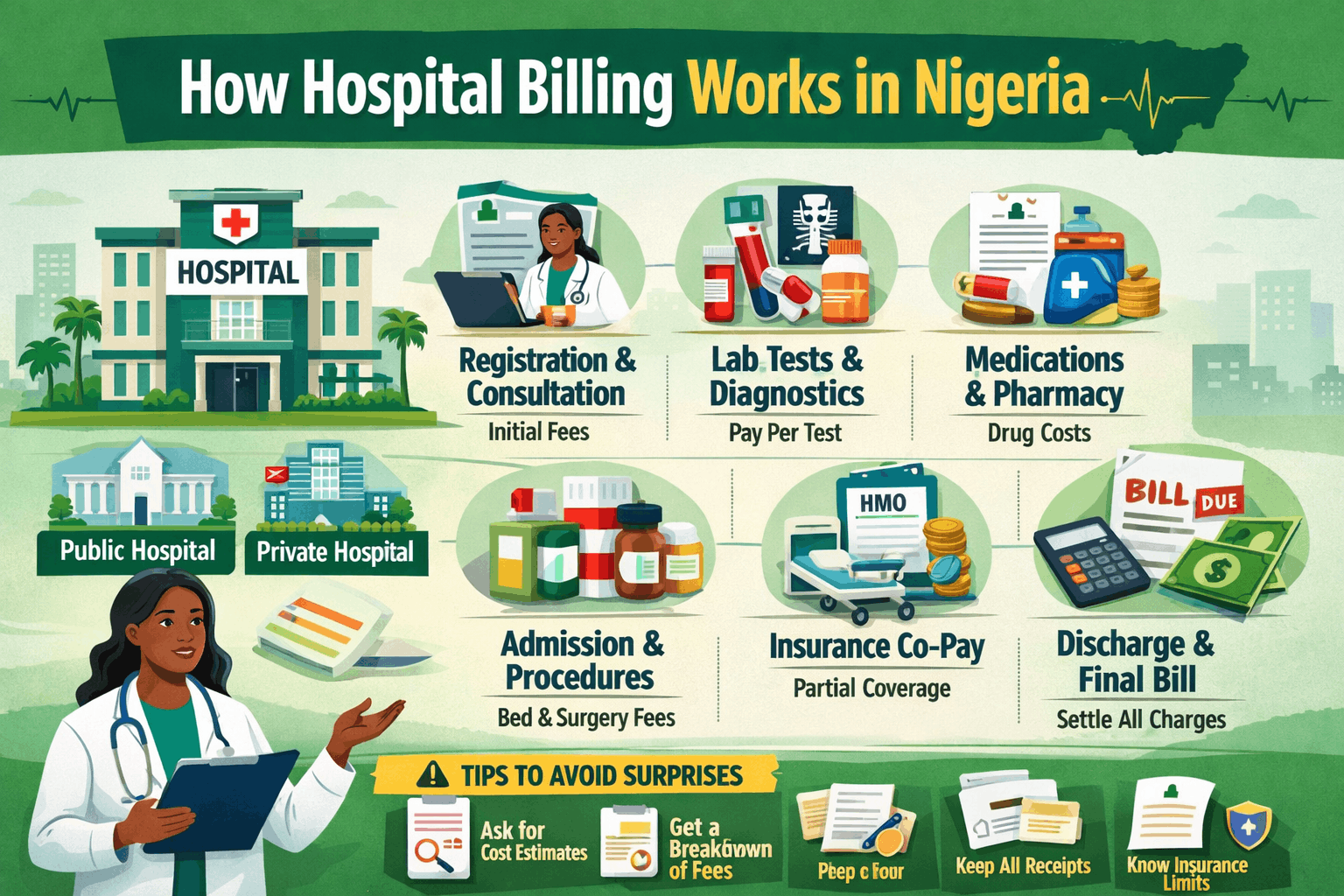
Hospital billing in Nigeria is often confusing for patients, especially first-timers. Many people walk into a hospital expecting to pay a single fee, only to discover that charges come in stages and from different departments. Understanding how hospital billing works helps you prepare financially, ask the right questions, and avoid unpleasant surprises.
This article explains how hospital billing typically works in Nigeria, from registration to discharge.
The Two Major Types of Hospitals
Hospital billing depends largely on the type of hospital you visit.
Public hospitals are owned by the government. They usually have lower consultation fees, but billing can be fragmented and slower. Payments may be made at different points, sometimes before services are rendered and sometimes after.
Private hospitals are owned by individuals or organizations. Their billing is usually more structured and faster, but costs are generally higher. Most private hospitals require payment before treatment except in emergencies.
Despite these differences, the billing process follows a similar pattern across most Nigerian hospitals.
Registration and Card Opening Fees
The first bill you encounter is the registration or card opening fee. This covers the creation of your hospital record and sometimes a basic consultation.
In public hospitals, card fees are usually cheap and paid once. In private hospitals, registration fees may be higher and sometimes renewed yearly.
This payment is often made before seeing a doctor, except in emergencies.
Consultation Fees
Consultation fees cover the doctor’s time and expertise. This fee varies depending on the hospital, the doctor’s level, and the department.
General outpatient consultations are cheaper than specialist consultations. For example, seeing a general practitioner costs less than seeing a surgeon or gynecologist.
In most cases, consultation fees are paid upfront before the doctor attends to you.
Laboratory and Diagnostic Charges
After consultation, the doctor may request laboratory tests or diagnostic procedures such as blood tests, X-rays, scans, or ultrasounds.
Each test has a separate cost. These charges are usually not included in the consultation fee.
Patients are often required to pay for these tests before they are conducted. In public hospitals, this may involve moving between departments and payment points. In private hospitals, billing is usually centralized.
Drug and Pharmacy Billing
Medicines are another major part of hospital billing. Prescribed drugs are billed separately from consultation and tests.
Some hospitals have in-house pharmacies, while others allow patients to buy drugs outside. In public hospitals, drugs may be subsidized or unavailable, forcing patients to purchase externally.
Private hospitals usually bill drugs directly and require payment before dispensing.
Admission and Bed Charges
If a patient needs to be admitted, additional charges apply. These include bed fees, ward fees, and sometimes admission deposits.
Bed charges depend on the type of ward. General wards are cheaper than private or special wards. Some private hospitals require a deposit before admission to cover anticipated expenses.
Daily bed charges accumulate until discharge.
Procedure and Treatment Costs
Procedures such as surgeries, wound dressing, injections, physiotherapy, and minor operations are billed separately.
Surgical billing usually includes several components:
Surgeon’s fee
Anesthesia fee
Theatre usage fee
Consumables such as gloves, syringes, and sutures
In most cases, hospitals provide an estimate before surgery, and payment is required in advance.
Nursing and Support Service Charges
Nursing care, especially in private wards, may attract additional charges. This includes monitoring, medication administration, and special care services.
Support services such as oxygen usage, blood transfusion handling, and special equipment may also be billed separately.
These costs are often overlooked until they appear on the final bill.
Health Insurance and Hospital Billing
Patients covered by health insurance experience hospital billing differently.
With insurance, approved services are billed to the insurance provider, while the patient pays only a portion known as co-payment. However, not all services are covered, and exclusions apply.
Insurance patients must follow approved hospital lists and procedures. Any service outside coverage is billed directly to the patient.
Understanding what your insurance covers helps prevent disputes at discharge.
Discharge Billing and Final Settlement
Before discharge, hospitals calculate the total cost of services rendered. This includes consultation, tests, drugs, bed charges, procedures, and miscellaneous services.
In public hospitals, discharge billing may take time due to manual processes. In private hospitals, it is usually faster but strictly enforced.
Patients are required to settle outstanding bills before discharge. Failure to do so may delay discharge, except in special circumstances.
Common Issues Patients Face
Many patients face unexpected charges because billing was not clearly explained at the beginning. Others assume some services are free or included when they are not.
Another common issue is price variation. The same service may cost different amounts in different hospitals or even within the same hospital, depending on circumstances.
Asking questions early helps reduce confusion.
How to Avoid Billing Surprises
Always ask for a breakdown of charges before treatment begins.
Request estimates for major procedures.
Clarify what is covered if you have insurance.
Keep receipts and payment records.
Ask questions whenever a new charge is introduced.
Being informed helps you make better decisions and manage costs effectively.
Final Thoughts
Hospital billing in Nigeria is not a single payment system but a collection of charges tied to each service provided. While the process may seem complex, understanding how it works puts you in control.
When patients understand billing structures, they are less likely to feel cheated or overwhelmed. Knowledge helps you prepare, ask the right questions, and focus on recovery rather than financial stress.


 Daniel Okoye