 Daniel Okoye
Internet access in Nigeria looks simple on the surface—you pay, you get connected—but behind that connection is a layered process involving infrastructure owners, service providers, regulators, and last-mile delivery systems. Understanding how internet service provisioning works helps you choose better plans, avoid unnecessary charges, and know who to hold responsible when things go wrong.
This article explains the real process, from international cables down to the router in your home.
The Foundation: International Internet Connectivity
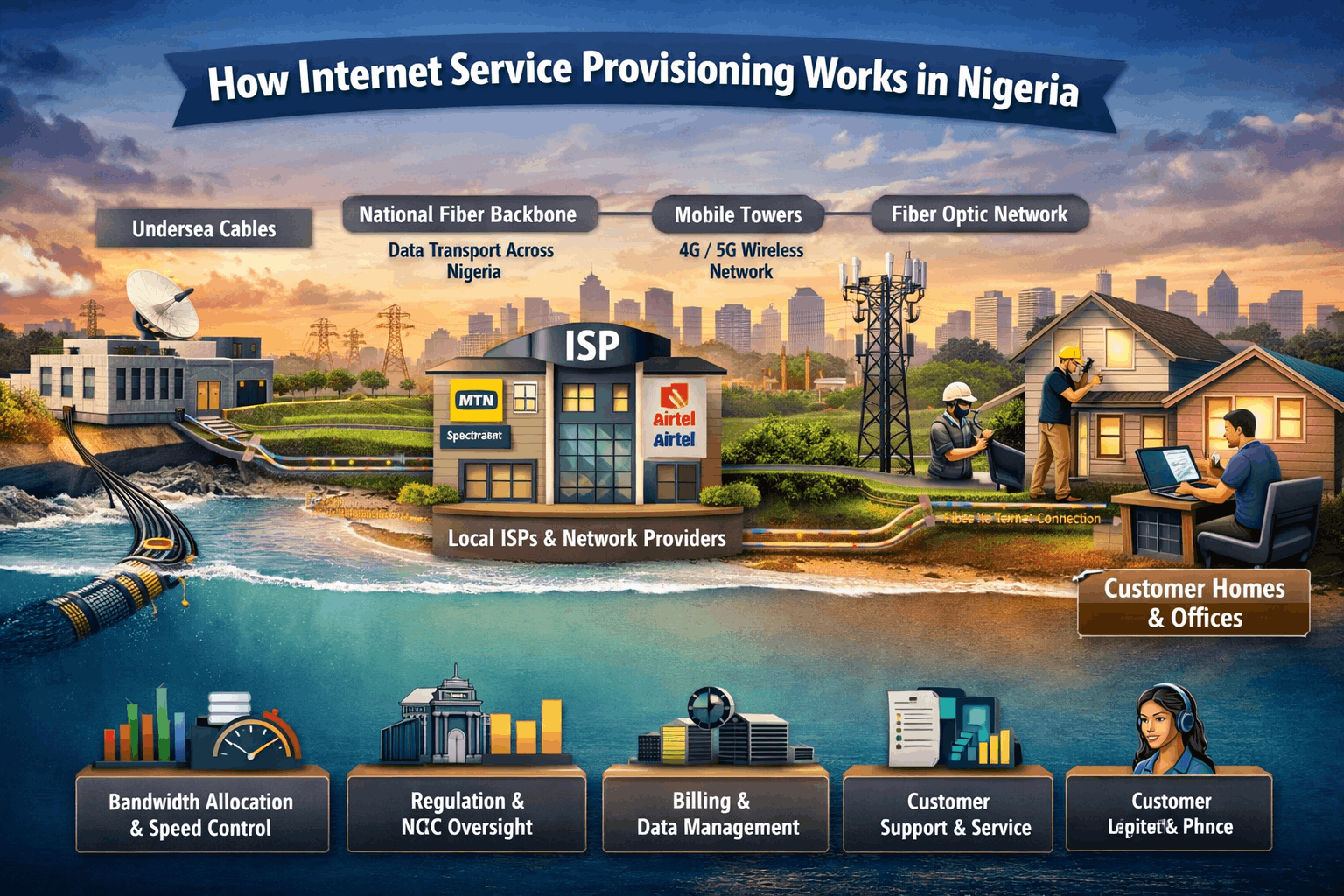
Nigeria does not generate the internet locally. Most of the data Nigerians use comes from undersea fibre-optic cables that connect the country to Europe, Asia, and other parts of the world.
These cables land in coastal areas, mainly Lagos, and are owned by large infrastructure companies. Internet Service Providers (ISPs) buy capacity from these cable owners. This capacity determines how fast and stable their internet can be.
If there is damage to an undersea cable, users across the country may experience slow speeds or outages, even if their local provider did nothing wrong.
The Role of National Backbone Providers
After international capacity enters Nigeria, it is distributed across the country through national fibre backbone networks. These are high-capacity fibre routes that move data from coastal landing points to major cities and regions.
Not all ISPs own nationwide fibre. Many smaller providers lease bandwidth from backbone companies. This is why internet quality can vary widely between cities and even between neighbourhoods.
Areas with limited fibre coverage often rely on wireless alternatives, which can be less stable.
Internet Service Providers (ISPs) Explained
ISPs are the companies consumers deal with directly. Examples include mobile network operators like MTN and Airtel, as well as dedicated internet companies like Spectranet.
ISPs perform several key functions:
-
Buy international and local bandwidth
-
Manage network infrastructure
-
Authenticate users
-
Assign IP addresses
-
Handle billing and customer support
They decide how data is packaged into plans, how speeds are capped, and how fair usage policies are applied.
Types of Internet Provisioning in Nigeria
Internet is delivered to users in Nigeria through different technologies. Each has its own provisioning process.
Mobile Data (2G, 3G, 4G, 5G)
This is the most common form of internet access. Provisioning happens through SIM cards registered to users. Once data is purchased:
-
The network authenticates the SIM
-
Data access is enabled on the user profile
-
Usage is tracked in real time
Mobile internet is fast to activate but speed depends heavily on location, network congestion, and signal strength.
Fixed Wireless Internet
This uses radio signals from base stations to a customer’s device or router. The ISP installs a receiver or provides a configured router. Provisioning involves:
-
Assigning the device to the nearest base station
-
Configuring bandwidth limits
-
Activating service on the ISP’s network
It is common in urban areas and estates.
Fibre to the Home (FTTH)
This is the most stable and fastest option but also the least available. Fibre provisioning involves:
-
Physical cable installation to the building
-
Network termination setup
-
Router configuration
-
Account activation
Provisioning can take days or weeks depending on location.
Customer Onboarding and Activation
Once a user subscribes to an internet plan, the ISP performs several backend steps:
-
Creates a customer account
-
Assigns authentication credentials
-
Links the customer to a network node
-
Applies the selected data or speed plan
Activation may be instant (mobile data) or delayed (fibre or fixed wireless). Delays usually happen due to installation logistics, not billing issues.
Bandwidth Allocation and Speed Control
ISPs do not give every user unlimited access to maximum speed at all times. Instead, they manage traffic using:
-
Bandwidth caps
-
Speed tiers
-
Fair usage policies
-
Network prioritisation
During peak hours, speeds may drop because multiple users share the same network segment. This is common in densely populated areas.
Billing, Data Tracking, and Fair Usage
Internet usage is tracked through network monitoring systems. These systems:
-
Measure data consumed
-
Enforce speed limits
-
Trigger throttling when limits are reached
In unlimited plans, “unlimited” often means speed is reduced after heavy usage, not that usage is truly infinite.
Billing cycles, rollover rules, and expiration policies are determined by the ISP, not regulators.
The Role of Regulation
The Nigerian Communications Commission (NCC) regulates ISPs. It sets guidelines for:
-
Licensing
-
Consumer protection
-
Quality of service benchmarks
However, the NCC does not control prices or guarantee speeds. Most service quality issues are resolved between customers and providers.
Why Internet Quality Varies So Much
Several factors affect internet quality in Nigeria:
-
Power supply instability
-
Fibre cuts from road construction
-
Network congestion
-
Equipment quality
-
Distance from base stations
A plan that works perfectly in one area may perform poorly just a few kilometres away.
Common Mistakes Users Make
Many users:
-
Assume all “unlimited” plans are the same
-
Choose providers without checking local coverage
-
Ignore fair usage policies
-
Use poor-quality routers that bottleneck speed
Understanding provisioning helps avoid these mistakes.
What Most People Don’t Know
Most ISPs do not own the entire internet chain. They depend on multiple upstream providers. This means:
-
One failure can affect many companies
-
Complaints may take time to resolve
-
Quality differences are often structural, not intentional
Final Thoughts
Internet service provisioning in Nigeria is a layered process involving international infrastructure, national fibre networks, ISPs, and local delivery systems. When you understand how these layers interact, you can make smarter choices, ask better questions, and set realistic expectations.
The internet is not just a product—it is a system. And like most systems in Nigeria, how it works behind the scenes explains a lot of what users experience every day.

 Daniel Okoye