 Daniel Okoye
Buying land in Nigeria goes beyond paying money and receiving a receipt. What truly secures ownership is proper documentation and the approval process behind those documents. Many land disputes in Nigeria today happen not because money was not paid, but because land documents were either incomplete, improperly processed, or never approved by the right authority.
This article explains, in simple terms, how land documents are processed and approved in Nigeria, from the moment land is identified to when ownership is legally recognized.
Understanding Land Ownership in Nigeria
All land in Nigeria is governed by the Land Use Act of 1978. Under this law, land is held in trust by the government for the people. This means that individuals do not own land absolutely; instead, they hold a right of occupancy, either statutory or customary.
Because of this structure, land documents must pass through specific processes before they are considered valid and recognized by law.
Step 1: Identifying the Land and Verifying Ownership
The process begins with identifying a piece of land and confirming who owns it. Ownership can fall under different categories such as:
- Family land
- Community land
- Government-acquired land
- Privately owned land
At this stage, basic documents may be shown, such as a family receipt, allocation letter, or previous deed. However, these documents alone do not guarantee full ownership.
A proper verification process usually includes checking the land’s history, confirming that it is not under government acquisition, dispute, or existing claims.
Step 2: Conducting a Land Survey
Once the land is confirmed to be available, a survey plan is prepared by a licensed surveyor. The survey plan shows the exact size, coordinates, and location of the land.
The survey is submitted to the Surveyor General’s office for confirmation. This step is critical because it determines whether the land falls within:
- Committed government acquisition
- Freehold (non-acquired land)
- Government-reserved land
If the land is under committed acquisition, processing stops unless proper government allocation exists.
Step 3: Executing a Deed of Assignment
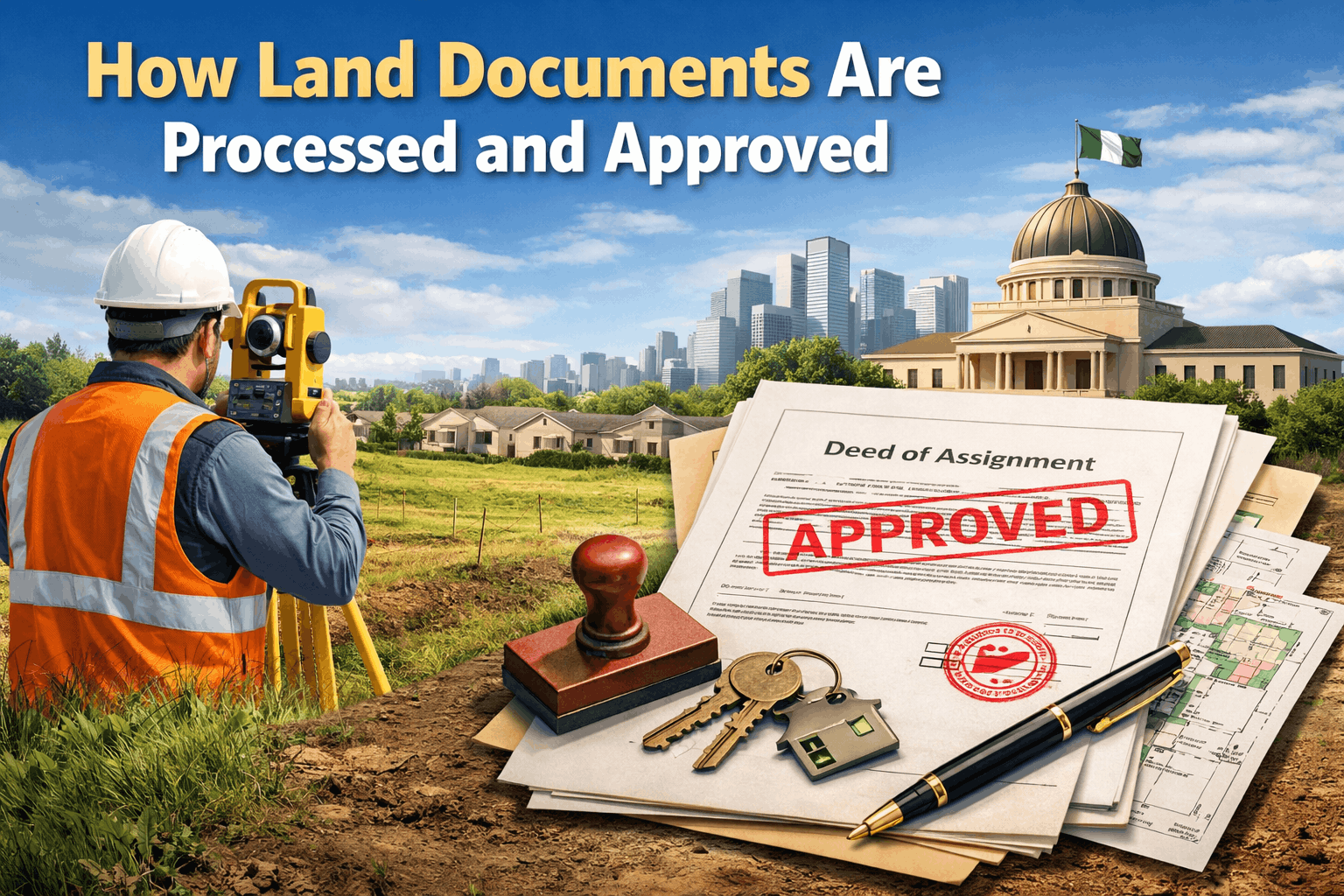
After verification and survey confirmation, a Deed of Assignment is prepared. This document transfers the interest in the land from the seller to the buyer.
The Deed of Assignment typically includes:
- Names of buyer and seller
- Description of the land
- Purchase amount
- Date of transfer
- Witnesses
Both parties sign the deed, but signing alone does not make it legally complete. The document must still pass through further processing stages.
Step 4: Stamping of the Deed
Stamping is done at the State Stamp Duties Office. This process confirms that the required government fees and taxes on the transaction have been paid.
An unstamped deed is considered inadmissible in court, meaning it cannot be used as evidence in legal disputes. Stamping usually attracts a fee calculated based on the value of the land.
Step 5: Registration at the Land Registry
After stamping, the Deed of Assignment is submitted to the Land Registry for registration. Registration officially records the transaction in government records.
This step ensures that:
- The buyer’s interest is publicly recognized
- The land cannot be sold multiple times without detection
- Ownership history is traceable
Registered deeds carry more legal weight than unregistered documents.
Step 6: Obtaining Governor’s Consent
Under Nigerian law, any transfer of land interest requires the Governor’s Consent. This is one of the most important approval stages.
The application for Governor’s Consent includes:
- Stamped Deed of Assignment
- Survey plan
- Tax clearance certificates
- Passport photographs
- Application forms
Once approved, the Governor’s Consent validates the transaction and legally confirms the buyer’s right of occupancy.
Step 7: Processing a Certificate of Occupancy (If Applicable)
In some cases, especially for newly allocated land or government land, a Certificate of Occupancy (C of O) is processed instead of Governor’s Consent.
The C of O serves as evidence of a statutory right of occupancy granted by the government. It goes through several stages including inspection, valuation, and final approval before issuance.
Not all land requires a new C of O, especially if one already exists and Governor’s Consent is obtained.
Common Delays in Land Document Processing
Land documentation in Nigeria is rarely instant. Delays often occur due to:
- Incomplete documentation
- Unpaid fees or taxes
- Conflicting land records
- Government bureaucracy
- Inaccurate survey details
Understanding that this process takes time helps buyers manage expectations and avoid shortcuts that may later cause problems.
Common Mistakes People Make
Many buyers make costly mistakes during land documentation, such as:
- Relying only on receipts or allocation letters
- Skipping survey verification
- Failing to register documents
- Ignoring Governor’s Consent
- Using unqualified agents or surveyors
These mistakes often surface years later during resale or disputes.
Why Proper Approval Matters
Properly processed and approved land documents:
- Protect ownership rights
- Prevent multiple sales
- Increase property value
- Make resale easier
- Reduce legal risks
A land document that has passed through stamping, registration, and consent is far more secure than one that has not.
Final Thoughts
Land document processing in Nigeria follows a structured but often misunderstood process. While it may seem complex, each stage exists to protect ownership and prevent disputes.
Understanding how land documents are processed and approved helps buyers make informed decisions, avoid scams, and secure their investments properly. The safest approach is always to prioritize documentation as much as the land itself.
At the end of the day, land without proper documents is not just risky—it is incomplete ownership.


 Daniel Okoye