 Daniel Okoye
Land ownership in Nigeria is governed by a combination of customary law and statutory law, especially under the Land Use Act. One of the most important land regularization processes particularly in states like Lagos, Ogun, and Oyo is land excision.
Many lands sold by communities and some real estate companies were once under government acquisition but later excised. Understanding excision is crucial to avoid buying land that could later be demolished or reclaimed by the government.
What Is Land Excision?
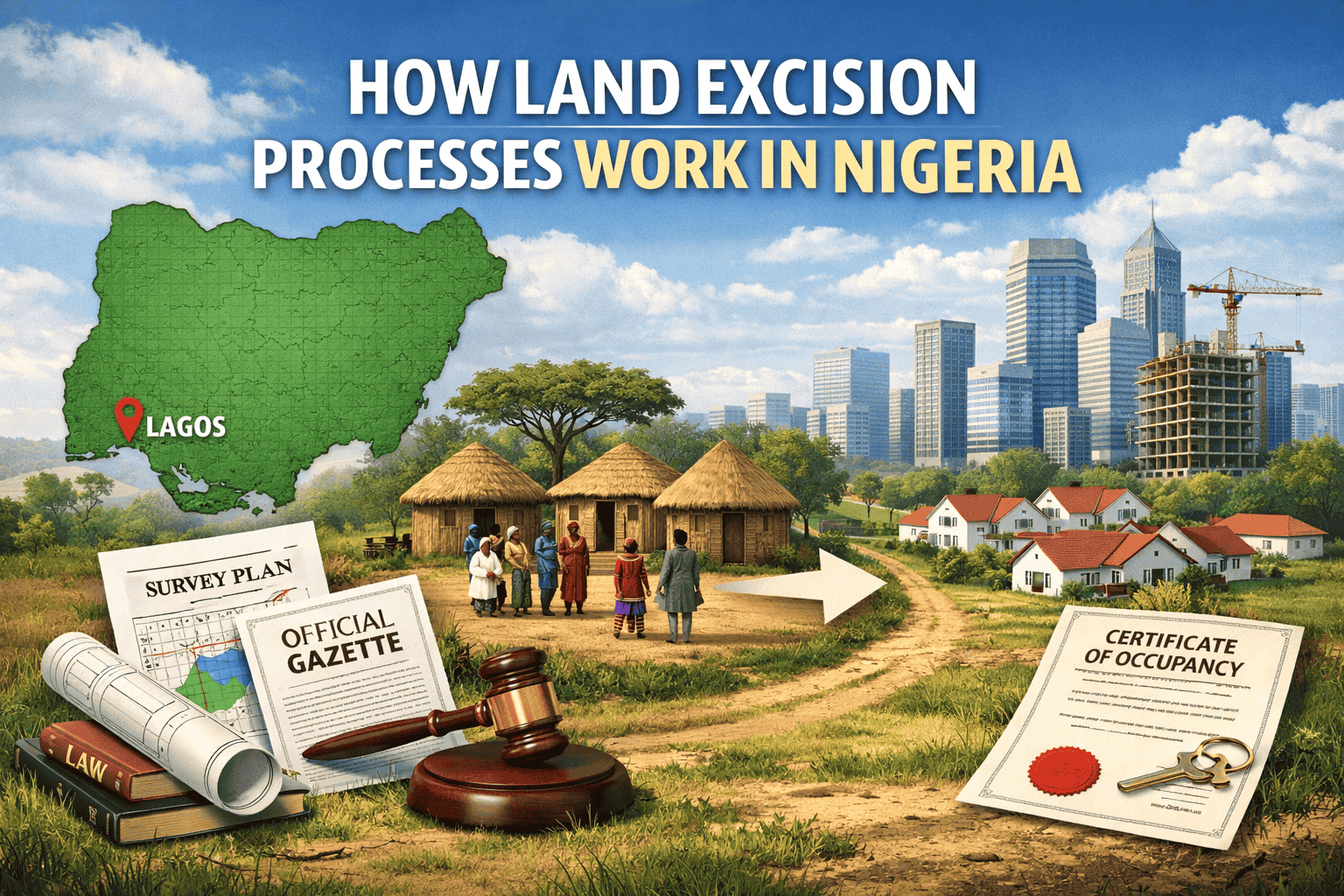
Land excision is the process through which the government releases a portion of land from its acquisition and officially recognizes the original indigenous community as the rightful owner.
When the government acquires land for public purposes such as roads, schools, housing estates, or infrastructure—the land legally becomes government property. However, if the government does not use all the acquired land, the original community can apply for excision.
If approved, that unused portion is released back to the community, and the community regains legal ownership and can sell it.
In simple terms:
-
Government acquires land
-
Community applies for unused portion
-
Government releases part of it
-
Community becomes legal owner again
Without excision, land under acquisition remains government property, even if communities are selling it informally.
Why Government Acquires Land
Government acquires land primarily for public interest and development.
Common reasons include:
-
Road and highway construction
-
Public schools
-
Housing estates
-
Industrial layouts
-
Hospitals and public institutions
-
Infrastructure development
Sometimes large areas are acquired, but only part is used. The unused portion becomes eligible for excision.
Legal Basis of Excision
Under the Land Use Act:
-
The state governor holds land in trust for the people
-
The governor can acquire land for public interest
-
The governor can release land back to communities
-
Excision is valid only after the governor’s approval
Without the governor’s consent, excision is not legally complete.
This is why properly approved and gazetted excision is considered relatively secure.
Step-by-Step Land Excision Process
Land excision follows an official procedure involving multiple stages.
1. Community Application
The indigenous community submits a formal application to the state government.
The application typically includes:
-
A letter requesting excision
-
Historical claim to the land
-
A survey plan
-
Description of boundaries
This is usually handled by the Baale (community head) and family representatives.
2. Survey and Charting
The government conducts charting to determine the land’s status.
Charting involves:
-
Comparing the community’s survey plan with government acquisition maps
-
Checking if the land falls within committed acquisition areas
-
Identifying overlaps
Possible outcomes:
-
Land falls within committed acquisition (not eligible)
-
Land falls within free acquisition (eligible)
-
Land partially falls within acquisition
This stage determines whether excision can proceed.
3. Government Inspection
Officials visit the land physically to inspect it.
They assess:
-
Existing developments
-
Population on the land
-
Whether government projects exist
-
Whether releasing the land affects public plans
This ensures public interest is protected.
4. Preparation of Excision Layout
If eligible, the government prepares an official excision layout showing:
-
The portion to be released
-
Boundaries of the excised area
-
Areas still under government control
This becomes part of government records.
5. Governor’s Approval
The excision file passes through several departments such as:
-
Ministry of Lands
-
Surveyor General’s Office
-
Land Bureau
-
Governor’s Office
Final approval must come from the governor.
Without this approval, excision remains incomplete.
6. Gazette Publication
After approval, the excision is published in a government gazette.
A gazette is the official government publication confirming that the land has been released.
It contains:
-
Community name
-
Land location
-
Size of land excised
-
Survey details
Gazette publication is permanent proof of excision.
Types of Excision
There are two major categories.
Approved Excision
This has:
-
Full government approval
-
Gazette publication
-
Legal recognition
It is considered safer and can be upgraded to a Certificate of Occupancy (C of O).
Excision in Process
This means:
-
Application has been submitted
-
Approval is not yet granted
-
Land is still under government acquisition
This carries higher risk because approval is not guaranteed.
Why Gazette Is Important
A gazette is the strongest proof that land has been excised.
It confirms:
-
Government approval
-
Exact boundaries
-
Community recognition
Without gazette evidence, claims of excision cannot be fully verified.
Benefits of Buying Excision Land
Excised land offers several advantages:
-
Government recognition
-
Lower cost than land with C of O
-
Can be upgraded to C of O
-
High appreciation potential
Many developing areas in Lagos—such as Ibeju Lekki, Epe, and Ikorodu—started as excision lands.
Risks of Buying Land Without Excision
Buying land under government acquisition without excision is risky.
Possible consequences include:
-
Demolition by government
-
Loss of investment
-
Inability to process C of O
-
Legal disputes
-
Revocation of ownership
Government can reclaim such land at any time.
How to Verify Excision Status
Before buying, take these steps:
-
Request the survey plan
-
Conduct charting at the Surveyor General’s Office
-
Request a copy of the gazette
-
Confirm excision number
-
Verify at the Ministry of Lands
Never rely on verbal assurances alone.
Difference Between Excision and Certificate of Occupancy
Excision and Certificate of Occupancy (C of O) are different.
Excision:
-
Releases land from government acquisition
-
Returns ownership to community
Certificate of Occupancy:
-
Confirms government recognition of an individual owner
The typical sequence is:
-
Government acquisition
-
Excision granted to community
-
Land sold to individual
-
Individual applies for C of O
Excision comes before C of O in many cases.
Role of Real Estate Companies
Reputable real estate companies often:
-
Verify excision status
-
Process layout approval
-
Apply for C of O
-
Provide legal documentation
However, buyers should still conduct independent verification.
Why Excision Is Common in Growing Cities
As cities expand:
-
Government acquires large areas
-
Communities apply for excision
-
Land becomes available for development
This supports urban expansion and real estate growth.
Conclusion
Land excision is a critical land regularization process in Nigeria. It is the legal mechanism through which the government releases unused acquired land back to indigenous communities. Once excision is approved and published in a gazette, the community gains legal authority to sell the land.
Understanding excision protects buyers from purchasing land under active government acquisition. Always verify excision status, confirm gazette evidence, and conduct proper charting through official government channels.
When properly approved, excised land provides a lawful pathway from government acquisition to private ownership and represents a valuable opportunity in Nigeria’s growing real estate market.

 Daniel Okoye