 Daniel Okoye
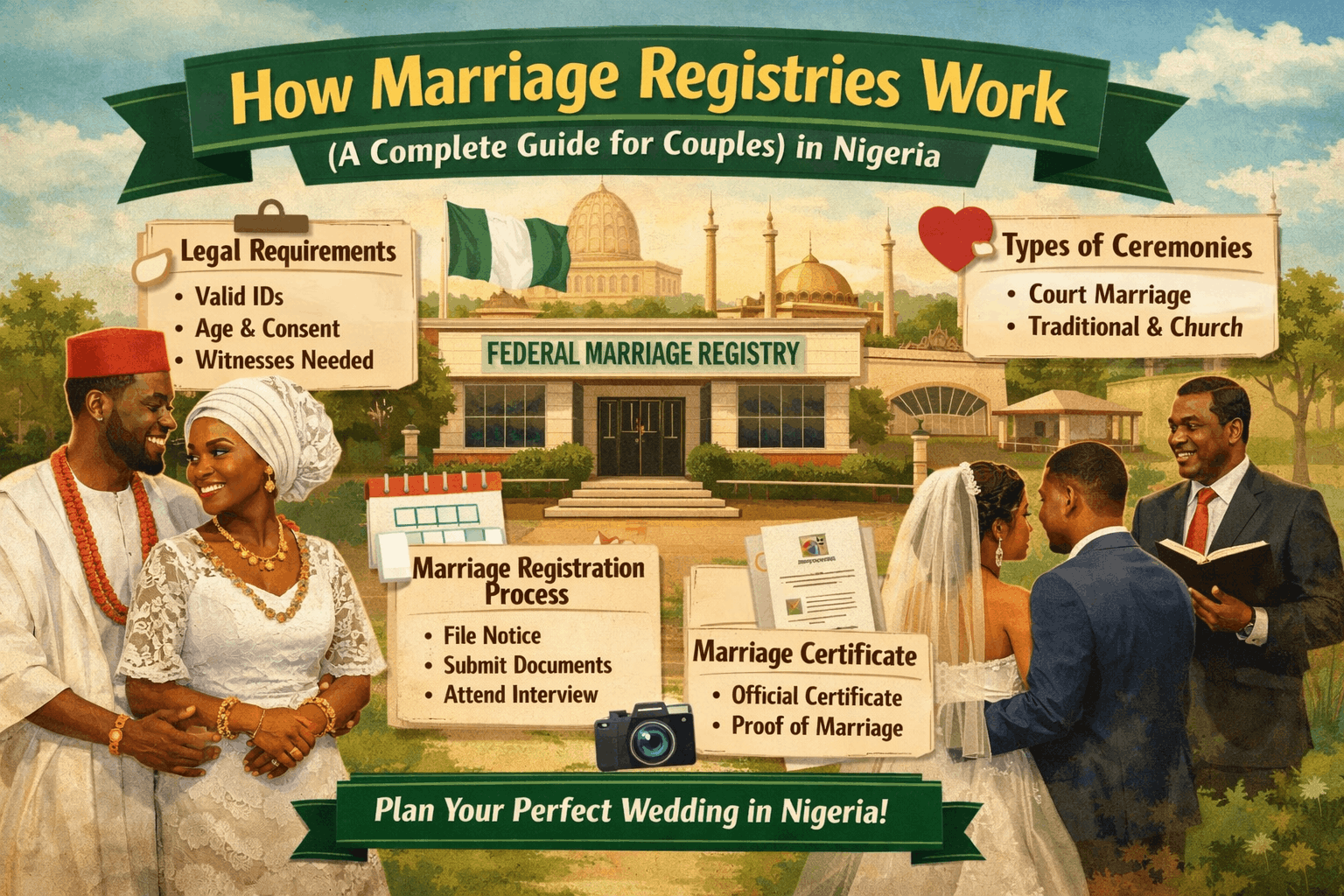
A marriage registry is an official government office where marriages are legally recorded and certified. It is different from a church or traditional wedding because the registry focuses on lawful recognition of the union.
Once your marriage is registered, the government recognizes you as legally married, and you receive an official marriage certificate. This certificate can be used for:
-
Passport applications
-
Visa processing
-
Name change
-
Bank or insurance documentation
-
Property ownership
-
Immigration or spousal benefits
In simple terms, the registry makes your marriage legal in the eyes of the law, not just cultural or religious.
In Lagos, for example, many couples use the popular Ikoyi Marriage Registry, but there are also local government registries across states.
Types of Marriage Registries
Marriage registries usually operate at different levels. The type you choose may affect the process and environment.
1. Federal Registry
-
Managed by the federal government
-
Recognized nationwide
-
Often more formal
-
Common in big cities
2. Local Government Registry
-
Managed by the local council
-
Easier and faster
-
More affordable
-
Suitable for simple legal weddings
3. Licensed Places of Worship
-
Churches or mosques approved to register marriages
-
Ceremony happens religiously but still legally recorded
All three options provide legal certificates, so choose based on your budget and preference.
Step-by-Step Process of Marriage Registration
Understanding the process makes everything smoother. Below is how most registries work.
Step 1: Notice of Marriage
This is the first and most important step.
You and your partner must:
-
Visit the registry together
-
Fill out a Notice of Marriage form
-
Submit passport photographs
-
Provide identification (National ID, voter’s card, or passport)
-
Provide addresses and occupation details
After submission, the registry displays your names publicly for 21 days.
Why 21 days?
This waiting period allows anyone to object if:
-
One partner is already married
-
One partner is underage
-
There is fraud or false information
If no objections arise, the marriage can proceed.
Step 2: Payment of Fees
Every registry has official fees.
Typical costs may include:
-
Notice filing fee
-
Marriage license fee
-
Certificate fee
-
Ceremony hall fee (optional)
Costs vary by state and location. Federal registries usually cost more than local ones.
Always request official receipts to avoid scams.
Step 3: Fixing a Wedding Date
After approval:
-
You select a date
-
Choose time (weekday or weekend)
-
Invite witnesses (minimum of two adults)
Some registries allow decorations or photography, while others keep it simple.
Step 4: The Marriage Ceremony
The ceremony is usually short and formal.
It typically includes:
-
Marriage officer’s introduction
-
Reading of legal vows
-
Exchange of consent (“I do”)
-
Signing of marriage register
-
Witnesses signing
-
Issuance of certificate
The entire process takes 10–20 minutes.
It’s simple but legally binding.
Step 5: Issuance of Marriage Certificate
After signing:
You receive:
-
Official marriage certificate
-
Registry seal or stamp
-
Registration number
This certificate is extremely important.
Make sure to:
-
Laminate or protect it
-
Scan and save digital copies
-
Keep it safe
Replacing a lost certificate can be stressful and time-consuming.
Documents Required
Before going to the registry, prepare these:
Basic Requirements
-
Passport photos (2–4 each)
-
Valid ID cards
-
Birth certificates or age declaration
-
Proof of address
If previously married
-
Divorce decree OR
-
Death certificate of former spouse
For foreigners
-
International passport
-
Immigration documents
-
Possible embassy letter
Requirements may differ slightly by state.
Benefits of Registering Your Marriage
Many couples underestimate how important legal registration is.
Here’s why it matters:
Legal Protection
-
Recognized by law
-
Prevents disputes
-
Protects inheritance rights
Property & Finance
-
Joint property ownership
-
Access to spouse’s benefits
-
Easier loan approvals
Immigration & Travel
-
Visa applications
-
Dependent permits
-
International recognition
Children’s Rights
-
Legitimate documentation
-
Easier birth registration
-
School and passport processing
Without registration, proving marriage legally can become difficult.
Common Mistakes to Avoid
Many couples make small errors that delay the process.
Avoid these:
-
Arriving late on ceremony day
-
Forgetting witnesses
-
Wrong spellings on forms
-
Using fake agents
-
Losing receipts
-
Not confirming fees beforehand
Always double-check every document.
Marriage Registry vs Traditional or Church Wedding
People often ask: “Is registry necessary if I have a church or traditional wedding?”
Here’s the difference:
Traditional Wedding
-
Cultural
-
Family-based
-
Not always legally recognized
Church Wedding
-
Religious
-
May or may not be licensed
Registry Wedding
-
Government-recognized
-
Legally binding
-
Provides certificate
Best option:
Many couples do all three — traditional, church, and registry.
That way, they satisfy:
-
Culture
-
Religion
-
Law
Tips for a Smooth Registry Experience
To avoid stress, follow these tips:
-
Arrive early
-
Dress neatly
-
Bring extra passport photos
-
Confirm witnesses ahead
-
Carry multiple IDs
-
Keep copies of documents
-
Book early for popular dates
Weekends and festive periods fill up quickly.
Final Thoughts
Marriage is more than celebration and photos it is also a legal contract.
A marriage registry ensures:
-
Your union is protected
-
Your rights are secured
-
Your future is safer
The process is simple:
Notice → Wait → Pay → Ceremony → Certificate
In just a few steps, you move from “couple” to legally married partners.
If you’re planning a wedding soon, don’t overlook the registry. It may be the shortest part of the celebration, but it’s the most important legally.


 Daniel Okoye