 Daniel Okoye
Open markets are one of the most active economic spaces in Nigeria. Every day, thousands of small transactions happen simultaneously—cash changes hands, goods move quickly, and value is created in ways that many people do not consciously notice. Understanding how money circulates in open markets helps explain why these markets remain resilient, even during tough economic periods.
This article breaks down how money enters, moves within, and exits open markets, and why the circulation system keeps them alive.
What an Open Market Really Is
An open market is more than a place where people buy and sell goods. It is a network of traders, suppliers, transporters, middlemen, customers, and service providers. Everyone plays a role in ensuring that money does not stay with one person for long.
Unlike formal retail spaces such as malls, open markets rely heavily on trust, relationships, and repeated daily transactions. This structure encourages rapid money movement.
How Money Enters the Market
Money enters open markets mainly through buyers. These buyers can be grouped into three categories.
The first group is end consumers. These are individuals buying food items, household goods, clothing, or tools for personal use. Their money usually comes from salaries, daily wages, business profits, or informal income.
The second group is retailers and resellers. These buyers purchase goods in bulk to resell elsewhere, such as neighborhood shops, roadside stalls, or smaller markets. Their spending injects larger sums of money into the market at once.
The third group is institutional or bulk buyers. These include restaurants, hotels, schools, and caterers who buy regularly. Although fewer in number, they introduce significant cash flow into the market.
Once this money enters the market, it rarely stays in one place.
How Money Moves Between Traders
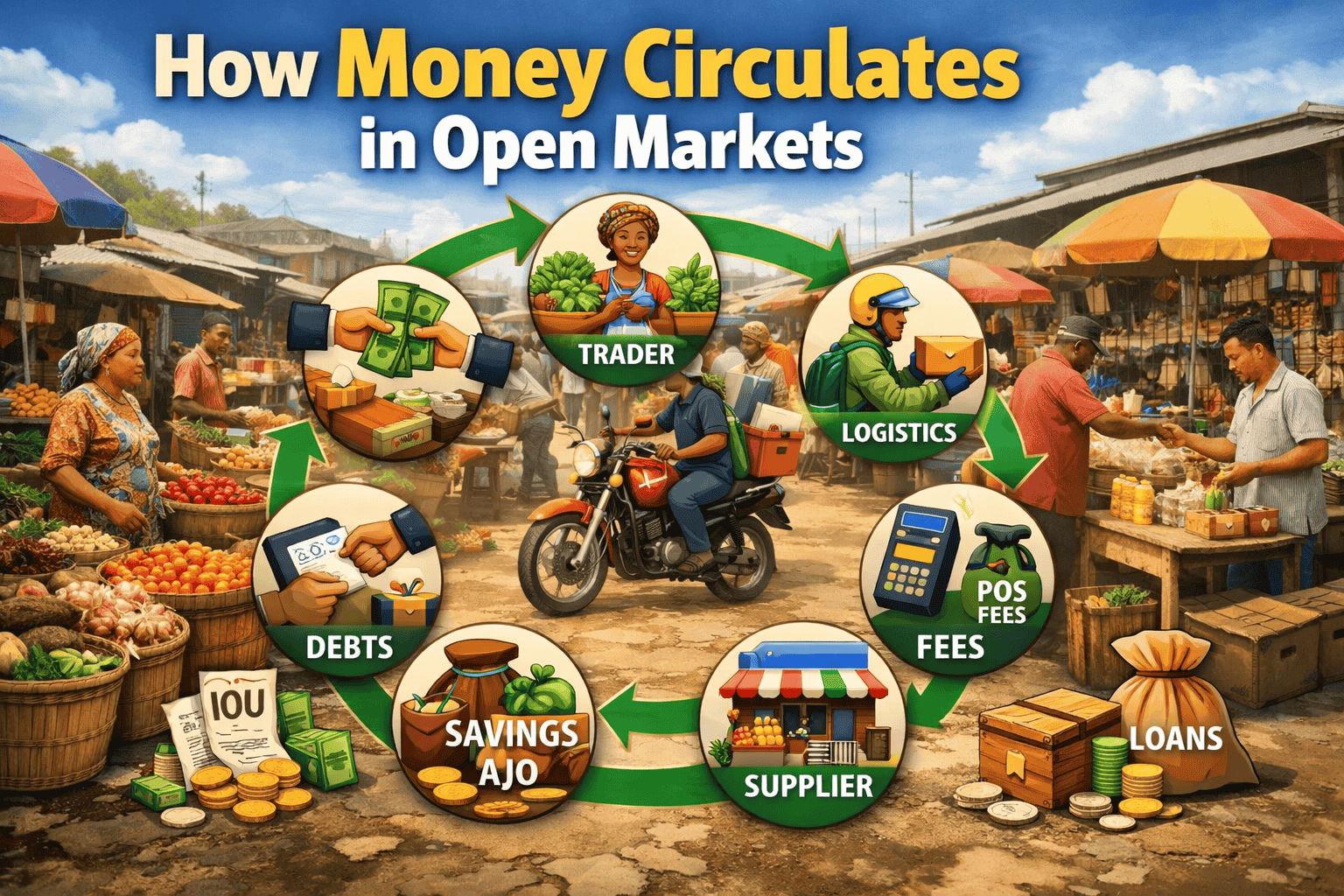
Money circulates quickly among traders because most sellers are also buyers. A vegetable seller uses the money made in the morning to buy pepper, tomatoes, or onions from wholesalers. The wholesaler, in turn, pays transporters, loaders, and suppliers.
This chain reaction continues throughout the day. A fish seller pays cold room operators. A grain seller pays suppliers from rural areas. A meat seller pays butchers and livestock traders.
Because most transactions are cash-based or instant transfers, money moves without delay. The same ₦10,000 can change hands multiple times in a single day.
The Role of Middlemen and Suppliers
Middlemen play a crucial role in money circulation. They connect farmers, producers, and importers to market traders. Although they do not always sell directly to final consumers, they keep money flowing by ensuring supply.
For example, a yam supplier collects money from retailers and immediately uses it to pay farmers, transporters, and storage providers. This prevents money from stagnating.
Suppliers from rural areas also contribute to circulation. When they receive payment, they spend it in their own communities, creating a wider economic loop beyond the market.
Daily Expenses That Keep Money Moving
Open markets have constant daily expenses that force money back into circulation. Traders pay for transportation, security, sanitation, loading and offloading, storage, and sometimes unofficial levies.
A trader who makes sales today will likely spend part of that money before leaving the market. Transport fare, food, packaging materials, and helpers’ wages all require immediate payment.
These small but frequent expenses ensure that money spreads across many hands rather than accumulating with one person.
Credit and Trust-Based Transactions
Although cash dominates open markets, credit also plays a role. Trusted customers may buy goods and pay later. Fellow traders may borrow small amounts to complete transactions.
This informal credit system speeds up circulation. Instead of waiting to gather full capital, traders continue selling, buying, and paying suppliers. Trust replaces paperwork, and money keeps moving.
However, this system works best in close-knit markets where reputation matters.
The Role of POS Agents and Cash Handlers
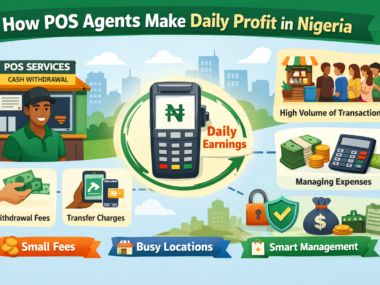
POS agents have become central to modern open markets. They help traders convert transfers to cash and vice versa. This service increases the speed at which money circulates.
Instead of leaving the market to visit a bank, traders withdraw or deposit money instantly. This keeps them active and selling.
POS agents themselves circulate money by collecting small fees and using the cash to serve multiple customers throughout the day.
How Money Leaves the Market
Money leaves open markets in several ways. Traders take profits home to support their families. Some reinvest in larger stock purchases outside the market. Others save through cooperatives or informal contribution systems.
Market associations also collect dues, which are used for maintenance, security, or shared services. Government levies and taxes also pull money out of the market system, though often gradually.
Even when money leaves, it usually returns in some form—through restocking, transportation, or new buyers.
Why Open Markets Survive Economic Pressure
Open markets survive inflation, fuel price increases, and policy changes because of how fast money circulates within them. Prices adjust quickly, costs are shared across the chain, and traders respond immediately to changes in demand.
Unlike rigid formal systems, open markets are flexible. When money becomes scarce, traders reduce margins, sell in smaller quantities, or extend credit. These adaptations keep circulation alive.
What Most People Don’t Notice
Many people think markets are chaotic, but they are highly organized systems of money movement. Every role—from hawkers to wholesalers—exists to prevent stagnation.
The strength of open markets lies not in large capital but in continuous circulation. As long as money keeps moving, the market stays alive.
Conclusion
Money circulates in open markets through constant buying, selling, spending, and reinvestment. The system relies on speed, trust, and daily necessity rather than formal structures.
Understanding this circulation explains why open markets remain central to Nigeria’s economy. They are not just places of trade; they are living systems where money is always in motion.

Daniel Okoye
Daniel Okoye is a writer and researcher at ProcesslyHub. I focus on explaining Nigerian systems, housing processes, and everyday business workflows in simple and practical terms. My goal is to help readers understand how real-world processes work so they can make informed decisions and avoid costly mistakes.

 Daniel Okoye