 Daniel Okoye
Private school fees in Nigeria often vary widely, even between schools located on the same street. One school may charge ₦50,000 per term, while another charges ₦300,000 or more. Many parents assume the difference is random or purely based on reputation, but school fees are actually determined using specific financial and business considerations.
Private schools in Nigeria operate as private businesses. Like any business, they must cover their operating costs and generate enough revenue to sustain their operations and growth.
This article explains clearly how private schools set their fees in Nigeria and the real factors behind school fee structures.
Quick Summary: How Private Schools Set Fees in Nigeria
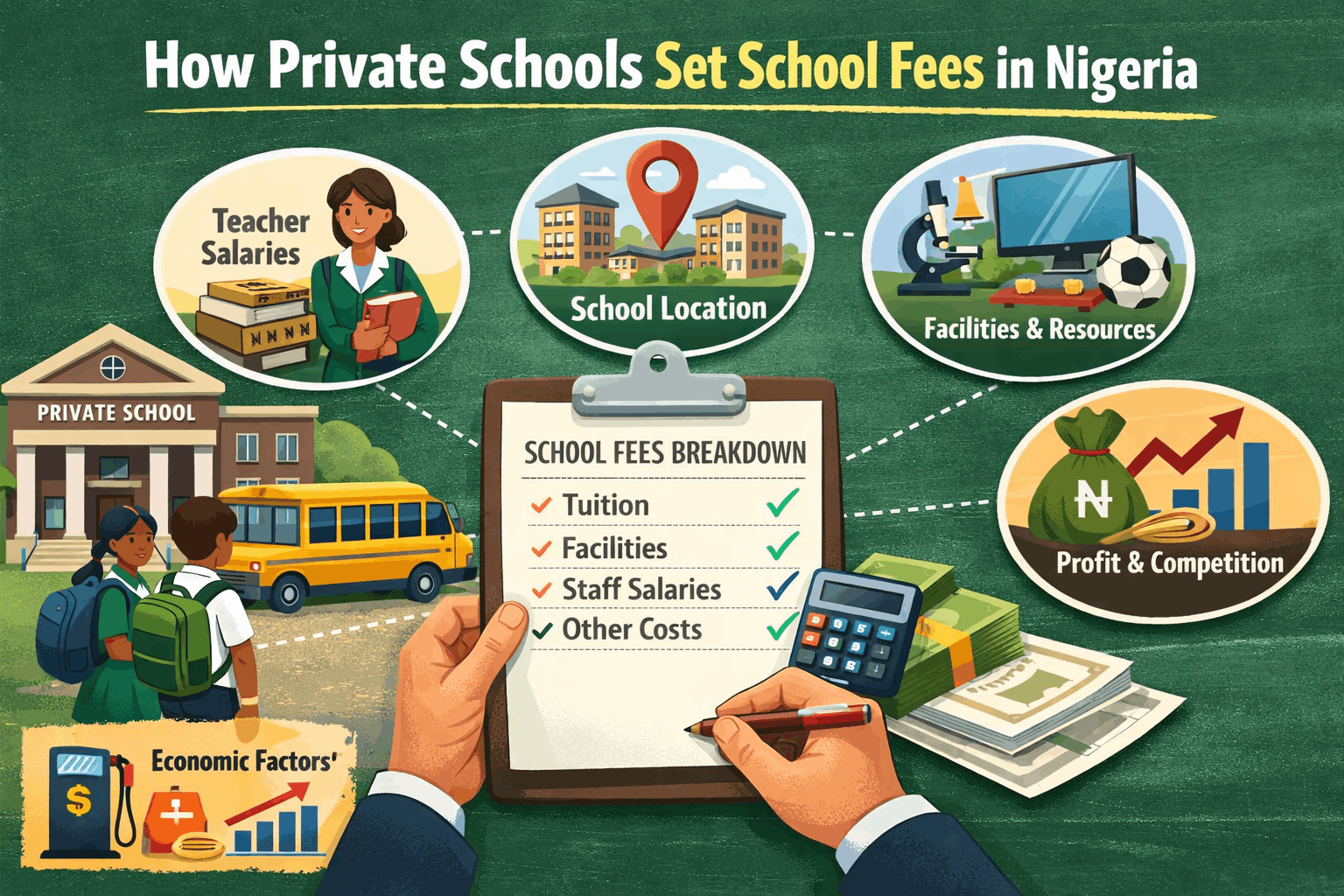
Private schools in Nigeria set their fees based on operating costs, teacher salaries, school location, facilities, curriculum, student population, and profit goals. They also consider inflation, competition, and long-term sustainability when determining how much to charge parents.
These decisions follow basic business pricing principles similar to other service-based industries. According to the Corporate Finance Institute, pricing decisions in service organizations are influenced by cost structure, market demand, and positioning.
Operating Costs Are the Primary Factor
The biggest factor that determines school fees is operating cost. Private schools must pay for many recurring expenses, including:
-
Building rent or land costs
-
Teacher and staff salaries
-
Electricity and fuel for generators
-
Classroom furniture and equipment
-
Security personnel
-
Maintenance and repairs
-
Administrative expenses
In Nigeria, electricity costs can be particularly high due to unreliable public power supply. Schools often rely heavily on generators. According to the Nigerian Electricity Regulatory Commission, electricity tariffs and supply challenges significantly affect operational expenses for institutions and businesses.
If a school’s operating costs are high, the school must charge higher fees to remain financially sustainable.
Teacher Salaries Play a Major Role
Teacher salaries represent one of the largest expenses for private schools.
Schools that employ:
-
Highly qualified teachers
-
Experienced educators
-
Specialized subject teachers
must pay higher salaries to attract and retain them.
Schools that pay higher salaries typically charge higher school fees to cover those costs.
According to education cost analysis explained by the World Bank, teacher compensation is one of the primary drivers of education operating costs globally.
School Location Significantly Affects Fees
Location has a major influence on school fees.
Schools located in high-income areas like:
-
Lekki
-
Ikoyi
-
Victoria Island
-
Maitama (Abuja)
usually have higher expenses due to:
-
Higher land or rent costs
-
Higher staff salary expectations
-
Higher operational costs
These schools often charge higher fees compared to schools in suburban or rural areas where expenses are lower.
Facilities and Infrastructure Affect Pricing
Schools that invest heavily in facilities usually charge higher fees.
Examples of costly facilities include:
-
Air-conditioned classrooms
-
Computer laboratories
-
Science laboratories
-
School buses
-
Sports facilities
-
Security systems
These facilities increase the school’s overall expenses.
Schools must recover these investments through school fees.
Curriculum Type Influences Fees
The curriculum offered by a school also affects pricing.
Schools offering international curricula such as:
-
British curriculum
-
International General Certificate of Secondary Education (IGCSE)
-
Montessori system
often charge higher fees.
This is because these curricula require:
-
Special training for teachers
-
Imported learning materials
-
Accreditation and licensing fees
Organizations like the Cambridge Assessment International Education provide international programs used by many Nigerian private schools, and implementation requires significant investment.
Profit and Sustainability Goals
Private schools are businesses. They must generate enough revenue not only to cover expenses but also to make profit and grow.
Profit allows schools to:
-
Expand facilities
-
Improve infrastructure
-
Hire better teachers
-
Maintain operational stability
Without profit, the school may struggle to survive long-term.
Inflation and Economic Conditions Affect School Fees
Inflation significantly affects school fees in Nigeria.
When the cost of:
-
Fuel
-
Electricity
-
Rent
-
Teaching materials
increases, schools must adjust fees to cover rising expenses.
According to the National Bureau of Statistics, inflation directly increases operational costs across sectors, including education.
This is one major reason why school fees increase over time.
Market Positioning and Competition
Schools also set their fees based on how they want to position themselves in the market.
Some schools position themselves as:
-
Premium schools
-
Mid-range schools
-
Budget schools
Their fees reflect this positioning.
Premium schools charge higher fees to reflect their brand image, facilities, and perceived quality.
Example: Real-Life Fee Difference
For example, a private school located in Lekki may charge ₦250,000 per term due to high rent, higher teacher salaries, and better facilities.
Meanwhile, a school in a lower-cost area may charge ₦60,000 per term because its operating expenses are lower.
Both schools are setting fees based on their individual cost structures and business models.
School Fees Are Based on Business and Financial Planning
Private schools do not choose fees randomly.
They typically calculate:
Total operating costs + Expected profit = Total revenue required
This total revenue is then divided among students to determine how much each student must pay.
This ensures the school remains financially sustainable.
Frequently Asked Questions
Why do private schools increase fees regularly?
Private schools increase fees due to inflation, rising operational costs, higher fuel prices, and salary adjustments.
Do higher fees mean better education?
Not always. Higher fees may reflect facilities and brand positioning, but quality depends on teaching effectiveness, management, and learning outcomes.
Why do schools in the same area charge different fees?
Differences in facilities, teacher salaries, operating costs, and business strategies cause variations in fees.
Are private schools regulated in Nigeria?
Private schools must register with state education authorities such as the Lagos State Ministry of Education, but they generally have flexibility in setting their fees.
Final Thoughts
Private school fees in Nigeria are determined by real financial and business factors, not random decisions.
Operating costs, teacher salaries, location, facilities, curriculum, inflation, and business strategy all influence how much schools charge.
Understanding these factors helps parents make better decisions when selecting schools and evaluating whether a school’s fees match the value it provides.
ProcesslyHub exists to explain systems like this clearly, helping Nigerians understand how real-world processes actually work.

Daniel Okoye
Daniel Okoye is a writer and researcher at ProcesslyHub. I focus on explaining Nigerian systems, housing processes, and everyday business workflows in simple and practical terms. My goal is to help readers understand how real-world processes work so they can make informed decisions and avoid costly mistakes.

 Daniel Okoye