 Daniel Okoye
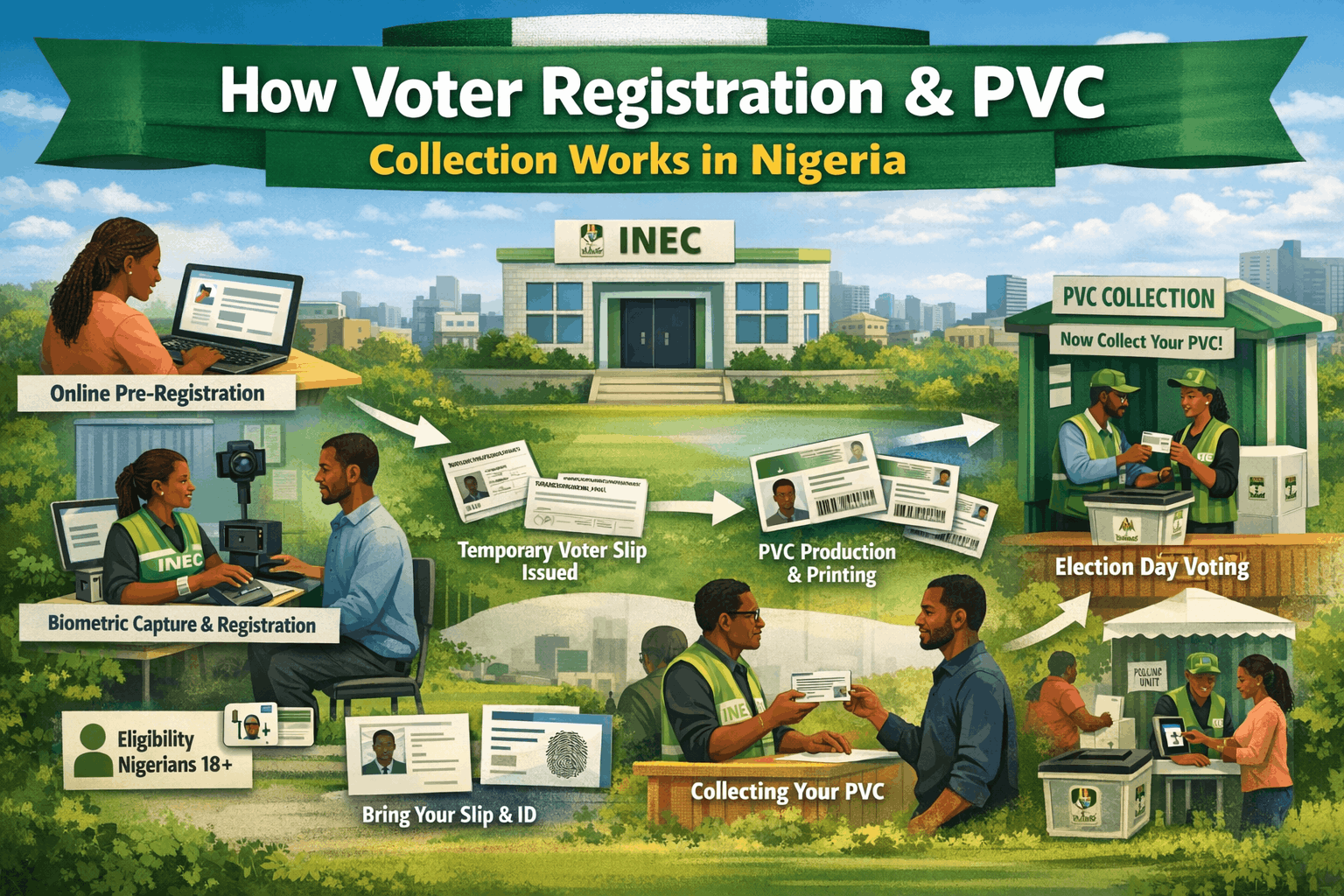
Voter registration and Permanent Voter’s Card (PVC) collection are the foundation of participating in elections in Nigeria. While many people know they need a PVC to vote, fewer understand how the process actually works, why delays happen, and what causes common issues. This article explains the process clearly, based on how it operates in practice.
Who Manages Voter Registration in Nigeria
Voter registration and PVC issuance are handled by the Independent National Electoral Commission (INEC). INEC is responsible for registering eligible voters, maintaining the voter register, and producing PVCs for elections at all levels.
No other agency can issue a PVC or register voters for elections in Nigeria.
Who Is Eligible to Register
To register as a voter in Nigeria, a person must:
-
Be a Nigerian citizen
-
Be at least 18 years old
-
Be resident in Nigeria at the time of registration
-
Not be legally disqualified from voting
INEC does not require proof of employment, tax records, or political affiliation. The process is meant to be free and open to all eligible citizens.
When Voter Registration Takes Place
Voter registration in Nigeria is not open all year round. INEC usually opens registration during specific periods known as Continuous Voter Registration (CVR).
CVR may be:
-
Nationwide and continuous for several months
-
Online and physical
-
Suspended close to election dates to allow data processing
Many people miss registration because they assume it is always available. Timing matters.
Online Pre-Registration Explained
In recent years, INEC introduced online pre-registration to reduce congestion at physical centers.
Online pre-registration allows applicants to:
-
Enter personal details
-
Upload basic information
-
Choose a registration center
However, online registration does not complete the process. It only speeds it up. Physical appearance is still mandatory for biometric capture.
Physical Registration and Biometric Capture
After online pre-registration or direct walk-in, the applicant must visit an INEC registration center.
At the center, INEC officials:
-
Capture fingerprints
-
Take a facial photograph
-
Confirm personal details
-
Assign a registration slip
This biometric data is what differentiates genuine voters from duplicates. If fingerprints or facial data fail verification later, registration may be rejected.
Issuance of Temporary Voter Slip
After successful registration, applicants are issued a Temporary Voter Slip (TVS). This slip confirms that registration was completed but it is not valid for voting.
Many people mistakenly believe the temporary slip can be used on election day. Only the PVC is accepted for voting.
How PVCs Are Produced
PVCs are not produced immediately at the registration center. After registration:
-
Data is transferred to INEC databases
-
Information is verified and cleaned
-
PVCs are printed centrally or in batches
This process takes time, especially during large registration periods. Errors in names, photos, or fingerprints can delay or cancel PVC production.
PVC Collection Process
PVC collection usually starts weeks or months after registration. INEC announces:
-
Collection dates
-
Collection centers
-
Categories of voters eligible for collection
PVCs are collected in person at designated INEC offices or registration centers. Collection by proxy is not allowed.
Requirements for PVC Collection
To collect a PVC, the voter must:
-
Appear physically
-
Present the Temporary Voter Slip
-
Sometimes provide identification if requested
INEC officials verify fingerprints before handing over the PVC. This prevents impersonation and fraud.
Why PVCs Are Sometimes Not Available
PVCs may be unavailable for several reasons:
-
Errors in registration details
-
Incomplete biometric capture
-
Duplicate registration attempts
-
Late registration close to election deadlines
-
Logistical delays in production or distribution
When PVCs are not ready, voters are usually advised to check back later or monitor official announcements.
Transfer and Update of Voter Information
INEC allows voters to:
-
Transfer their registration to another location
-
Correct errors in names or dates of birth
-
Replace lost or damaged PVCs
These services are only available during active CVR periods. Requests outside official timelines are not processed.
Common Mistakes Voters Make
One common mistake is waiting until election season to register. Another is failing to collect PVCs early when announced.
Some people also attempt multiple registrations, which leads to disqualification during data cleaning. Others lose their temporary slips and struggle during PVC collection.
Why Physical Presence Is Mandatory
INEC insists on physical presence because voter registration relies heavily on biometric verification. This reduces:
-
Multiple registrations
-
Identity theft
-
Electoral fraud
Online systems support the process but cannot replace physical biometric capture.
What Happens on Election Day
On election day:
-
Voters present their PVC
-
Accreditation is done using biometric devices
-
Only verified voters are allowed to vote
Without a PVC, even a registered voter cannot participate.
Final Thoughts
Voter registration and PVC collection in Nigeria are structured processes designed to protect the integrity of elections. While delays and challenges exist, understanding how the system works helps voters plan better and avoid last-minute frustration.
Registering early, following official announcements, and completing every stage of the process are the best ways to ensure participation in Nigeria’s electoral process.


 Daniel Okoye