 Daniel Okoye
The National Identity Number (NIN) is one of the most important identification numbers issued to citizens and legal residents in Nigeria. It is a unique 11-digit number assigned after successful registration into the National Identity Database.
The NIN serves as a permanent identity for life and is used by government agencies and private institutions to verify identity, reduce fraud, and improve planning. This article explains how NINs are assigned, the registration process, and how the system works in Nigeria.
What Is the National Identity Number (NIN)?
The National Identity Number (NIN) is a unique 11-digit number assigned to an individual after their biometric and demographic data have been captured and verified.
Key features of the NIN include:
-
It is unique to one person
-
It cannot be reassigned
-
It remains valid for life
-
It links all identity records of an individual
-
It is issued by the National Identity Management Commission
Unlike phone numbers or bank account numbers, the NIN does not change, even if you change your name, address, or other personal details.
Role of the National Identity Management Commission (NIMC)
The National Identity Management Commission (NIMC) is the federal agency responsible for managing Nigeria’s identity database.
Its responsibilities include:
-
Registering citizens and legal residents
-
Capturing biometric data
-
Assigning NINs
-
Maintaining the National Identity Database
-
Issuing National ID cards
-
Providing identity verification services
NIMC ensures that each person is issued only one NIN to prevent duplication and identity fraud.
Who Is Eligible for a NIN?
Every Nigerian citizen and legal resident is eligible to obtain a NIN.
This includes:
-
Nigerian citizens (newborns, children, adults)
-
Nigerians born abroad
-
Foreign nationals legally residing in Nigeria
-
Residents with valid immigration permits
There is no age restriction. Even newborn babies can be assigned a NIN.
Information Required Before NIN Assignment
Before a NIN is generated, NIMC collects two main categories of information.
Demographic Information
This includes:
-
Full name
-
Date of birth
-
Place of birth
-
Gender
-
Residential address
-
Phone number
-
Email address (optional)
-
State and Local Government of origin
Biometric Information
This includes:
-
Fingerprints
-
Facial photograph
-
Digital signature
Biometric capture ensures that each individual can only register once.
Step-by-Step Process of Assigning a NIN
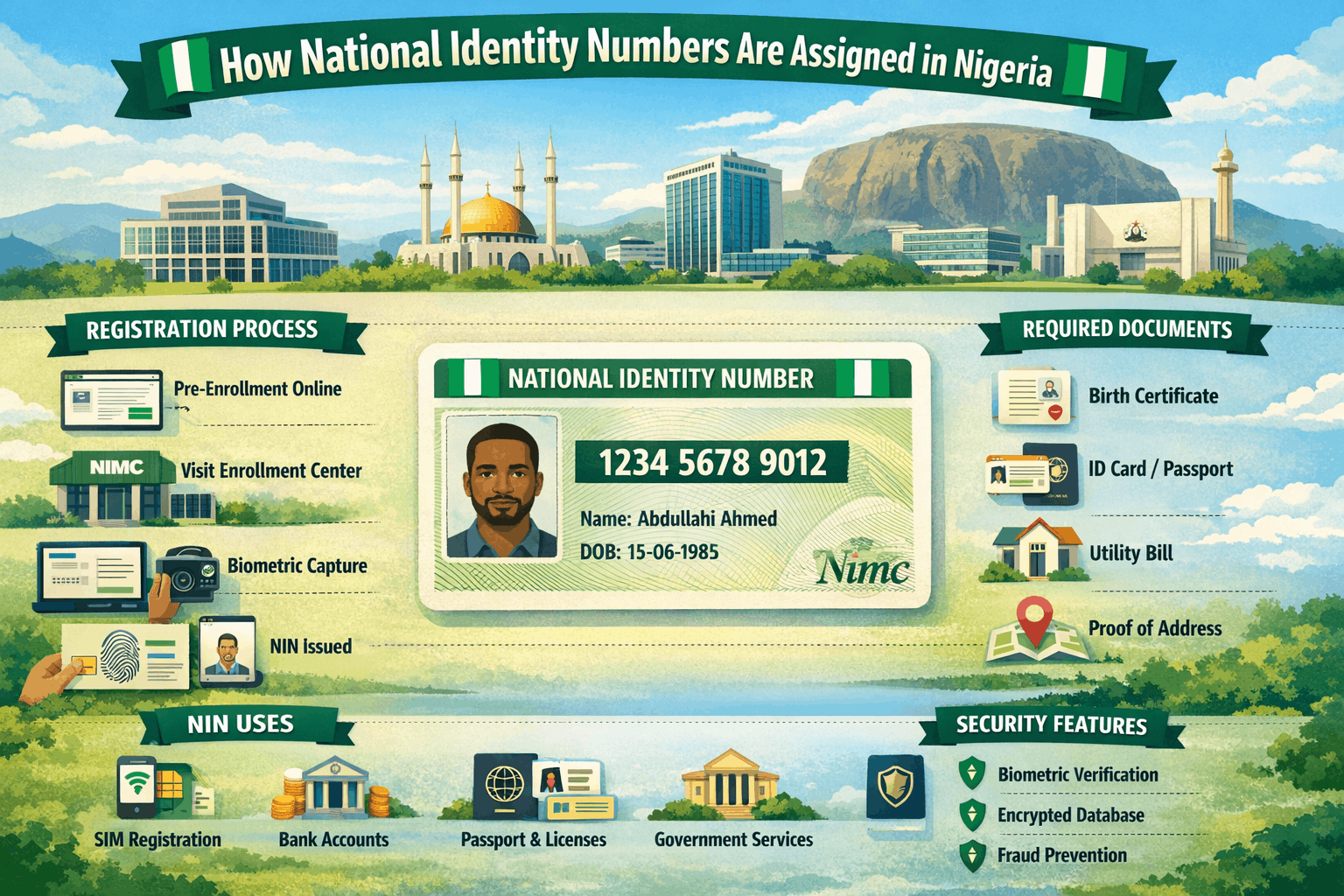
The assignment of a NIN follows a structured process to ensure accuracy and uniqueness.
Step 1: Pre-Enrollment (Optional)
Applicants may begin online by filling out details on the NIMC pre-enrollment portal.
This involves:
-
Completing personal details online
-
Printing a pre-enrollment slip
-
Booking an appointment
Pre-enrollment reduces waiting time at physical centers.
Step 2: Visit an Enrollment Center
Applicants must visit an official enrollment center.
Enrollment centers may include:
-
NIMC offices
-
Accredited telecom centers
-
Selected banks
-
Immigration offices
-
Government-approved registration partners
Applicants are required to bring supporting documents such as:
-
Birth certificate
-
International passport
-
Voter’s card
-
Driver’s license
-
School ID (for students)
Children can be registered using their birth certificate and a parent’s NIN.
Step 3: Biometric and Data Capture
At the center, officials capture:
-
Personal details
-
Fingerprints
-
Facial image
-
Digital signature
All information is uploaded into the National Identity Database.
Step 4: Verification and De-duplication
The system checks whether the applicant has previously registered.
It compares:
-
Fingerprints
-
Facial data
-
Personal information
This step prevents duplicate registrations.
Step 5: Generation of the NIN
Once verification is successful, the system generates a unique 11-digit number.
The NIN is randomly generated by a secure system and does not reveal personal details such as state or date of birth.
The number becomes permanently assigned to the individual.
Step 6: Issuance of NIN Slip
After assignment, the applicant receives a NIN slip showing:
-
Full name
-
NIN
-
Photograph
-
Enrollment ID
This slip serves as proof of registration.
How Long It Takes to Get a NIN
In many cases, the NIN is generated shortly after registration. However, processing time can vary.
Possible timelines include:
-
Immediate generation
-
A few days
-
Several weeks in cases of heavy application volume
Delays may occur due to:
-
High registration demand
-
Technical issues
-
Incomplete documentation
Applicants can retrieve their NIN using their registered phone number.
Uses of the NIN in Nigeria
The NIN is now mandatory for many services.
It is required for:
-
SIM card registration and linking
-
Opening bank accounts
-
Obtaining international passports
-
Driver’s license applications
-
Voter registration
-
Government benefit programs
-
Tax registration
The NIN allows institutions to verify identity quickly and accurately.
Linking NIN to Other Services
The Nigerian government requires NIN to be linked to several identity systems.
Examples include:
-
SIM registration
-
Bank Verification Number (BVN)
-
Passport records
-
Tax Identification Number (TIN)
Linking creates a unified identity database.
Benefits include:
-
Reduced fraud
-
Stronger national security
-
Easier verification
-
Improved service delivery
NIN for Children
Children can also be assigned a NIN.
Requirements include:
-
Birth certificate
-
Parent or guardian’s NIN
For very young children, biometric capture may be limited, but a NIN will still be generated. Full biometric updates can be completed later.
Security and Protection of NIN Data
NIMC uses secure systems to protect personal information.
Security measures include:
-
Biometric authentication
-
Encrypted databases
-
Controlled system access
-
Identity verification protocols
These measures help reduce identity theft and data misuse.
Common Challenges During Registration
Some applicants experience issues such as:
-
Data mismatch
-
Lost NIN slip
-
Duplicate enrollment
-
Delayed processing
Solutions may include:
-
Visiting a NIMC office for correction
-
Requesting data update
-
Retrieving NIN using a registered phone number
-
Reprinting the NIN slip
Corrections can be made for errors in names, dates of birth, and other details.
Difference Between NIN and National ID Card
The NIN and the National ID card are related but different.
NIN:
-
The 11-digit number
-
Permanent and unique
-
Exists in the database
National ID Card:
-
The physical card
-
Displays the NIN
-
Serves as physical proof of identity
The NIN itself is more important because it is stored in the national database even without the card.
Importance of the NIN System
The NIN system strengthens Nigeria’s identity management structure.
Its benefits include:
-
Improved national security
-
Reduced identity fraud
-
Better planning and service delivery
-
Easier access to public services
-
Enhanced economic and population data management
It supports Nigeria’s transition toward digital governance.
Conclusion
The National Identity Number is a permanent and unique identification number issued by the National Identity Management Commission to every citizen and legal resident in Nigeria. The process involves collecting biometric and demographic data, verifying identity, and generating a unique 11-digit number that remains valid for life.
The NIN is now essential for accessing banking, telecommunications, immigration, and many government services. As Nigeria continues to digitize its systems, the NIN plays a central role in identity verification, national security, and development planning.
Registering for a NIN ensures full participation in essential services and strengthens the country’s identity infrastructure.


 Daniel Okoye