 Daniel Okoye
Census data is the official count of a country’s population and housing units. In Nigeria, census data provides critical information about how many people live in the country, where they live, their age, gender, occupation, and housing conditions. This information helps government plan schools, hospitals, roads, electricity, housing, and other essential services. It also affects political representation, revenue allocation, and long-term national development.
The responsibility for conducting census exercises in Nigeria lies with the National Population Commission (NPC). This federal agency is legally empowered to organize, supervise, and publish census results nationwide.
Conducting a census in a country with over 200 million people requires careful planning, trained personnel, logistics coordination, and increasingly, digital technology.
Legal Framework for Census in Nigeria
Census activities in Nigeria are backed by law. The National Population Commission Act gives the NPC the authority to conduct population and housing censuses and maintain demographic data.
The legal framework ensures that:
-
Every person in Nigeria is counted
-
Census officials are legally authorized to collect information
-
Citizens are expected to cooperate
-
Personal information remains confidential
-
Data is used strictly for statistical and planning purposes
Confidentiality is critical. Individual responses are not made public and cannot legally be used for taxation, immigration enforcement, or law enforcement purposes.
Types of Census Conducted in Nigeria
Nigeria usually conducts both population and housing census at the same time.
Population Census
This focuses on counting people and collecting demographic information such as:
-
Age
-
Gender
-
Occupation
-
Marital status
-
Education level
-
Disability status
Housing Census
This collects information about buildings and living conditions, including:
-
Type of building
-
Number of rooms
-
Access to electricity
-
Source of water
-
Toilet facilities
-
Construction materials
Combining both provides a complete picture of population and living standards.
Preparatory Stage Before Data Collection
Before the actual counting begins, the NPC carries out several preparatory activities.
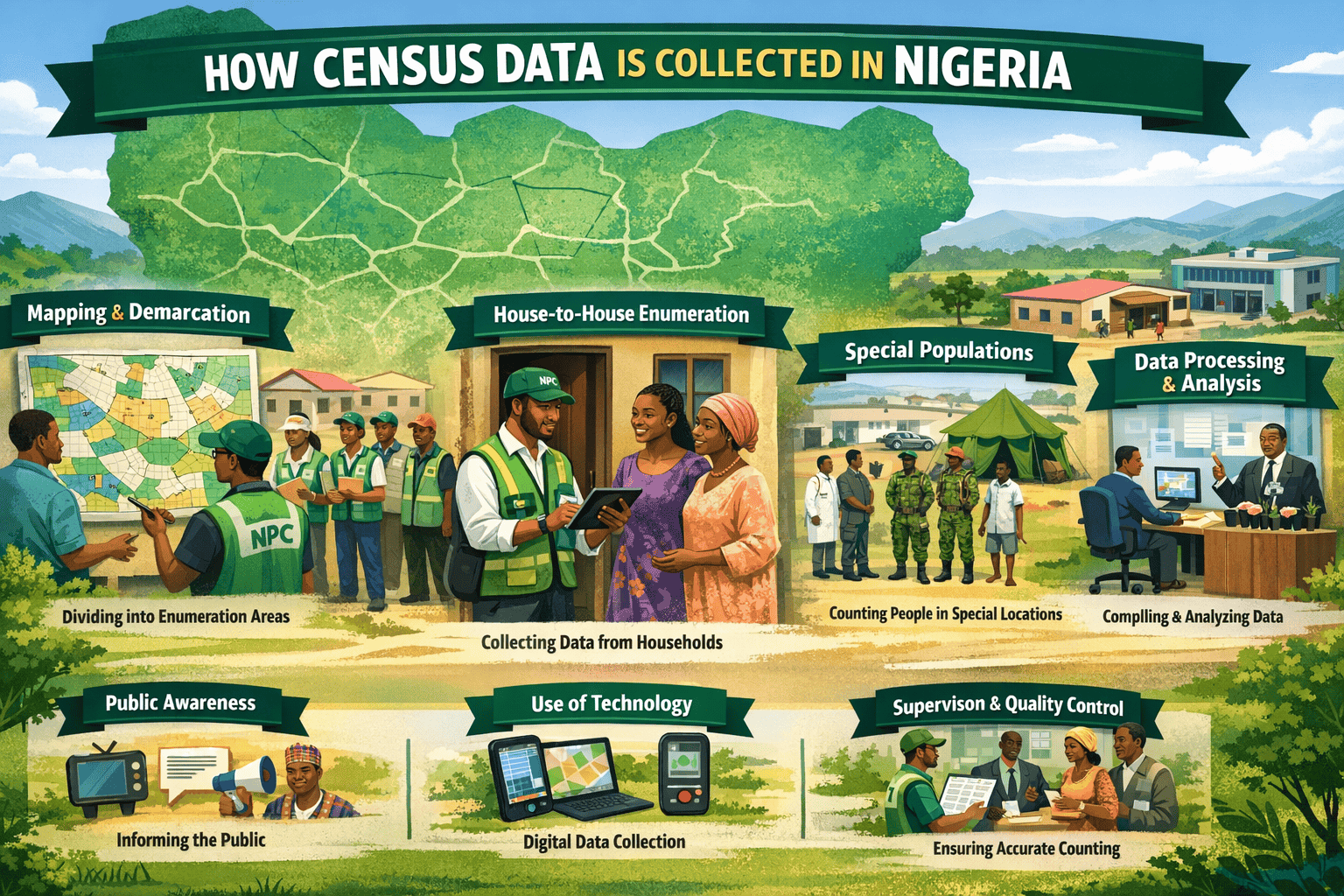
Mapping and Demarcation
The country is divided into small units called Enumeration Areas (EAs). Each EA contains a manageable number of households for one enumerator.
During this stage:
-
Streets are mapped
-
Buildings are identified
-
Boundaries are clearly defined
-
Digital maps are created
This ensures no location is omitted or counted twice.
Recruitment of Census Workers
Thousands of temporary workers are recruited for census operations. These include:
-
Enumerators
-
Supervisors
-
Field coordinators
-
Data managers
Enumerators are responsible for visiting households and collecting information directly.
Selection often depends on:
-
Minimum educational qualification
-
Literacy and communication skills
-
Familiarity with the local area
-
Reliability and good conduct
Training of Census Officials
All recruited workers undergo training before deployment. Training covers:
-
How to ask census questions properly
-
How to record answers accurately
-
Use of digital devices
-
Ethical conduct and confidentiality
-
Proper engagement with households
Training ensures consistency across the country.
Public Awareness and Sensitization
Before the census begins, awareness campaigns are launched through:
-
Television and radio
-
Newspapers
-
Social media
-
Religious institutions
-
Traditional leaders
-
Community meetings
Key messages include:
-
Census is not for taxation
-
Census is confidential
-
Everyone must be counted
-
Participation is a civic responsibility
Public cooperation is essential for accurate results.
The Enumeration Stage: House-to-House Counting
The enumeration stage is the core of the census exercise.
House-to-House Visits
Enumerators visit every household within their assigned Enumeration Area.
During visits, they:
-
Introduce themselves with official identification
-
Explain the purpose of the census
-
Ask structured questions
-
Record responses
Information collected includes:
-
Number of people in the household
-
Names and ages
-
Gender
-
Relationship to household head
-
Education level
-
Employment status
De Facto Counting Method
Nigeria uses the de facto method of enumeration. This means individuals are counted where they slept on census night.
For example:
-
A traveler is counted where they spent the night
-
A student in a hostel is counted at the hostel
-
A hospital patient is counted in the hospital
This reduces the risk of double counting or omission.
Use of Digital Technology
Recent census preparations in Nigeria have adopted digital tools instead of paper forms.
Enumerators now use:
-
Tablets
-
GPS-enabled devices
-
Digital questionnaires
Benefits of digital census include:
-
Faster data collection
-
Reduced manual errors
-
Accurate geographic tracking
-
Faster processing of results
Technology improves efficiency and transparency.
Counting Special Populations
Certain groups require special arrangements to ensure they are counted properly.
These include:
-
Hospital patients
-
Prison inmates
-
Military personnel
-
Nomadic populations
-
Homeless individuals
-
Hotel occupants
Special teams are assigned to cover these groups. Nomadic populations, such as pastoral communities, are tracked through tailored strategies to avoid exclusion.
Supervision and Quality Control
Supervisors monitor enumerators to maintain data accuracy.
Their duties include:
-
Checking completed entries
-
Ensuring full area coverage
-
Correcting mistakes
-
Providing guidance
Field coordinators oversee larger areas to ensure compliance with standards.
Quality control mechanisms reduce fraud, duplication, and data gaps.
Data Transmission and Processing
After collection, data is transmitted to central processing centers.
Processing involves:
-
Verifying entries
-
Cleaning errors
-
Removing duplicates
-
Organizing data for analysis
Data analysts and statisticians then examine the compiled records.
Digital systems significantly speed up processing compared to traditional paper-based methods.
Data Analysis and Publication
After verification and analysis, the NPC publishes census results.
Published results typically include:
-
Total national population
-
Population by state
-
Population by local government area
-
Age distribution
-
Gender distribution
-
Housing statistics
These figures are used by:
-
Federal and state governments
-
Policy makers
-
Researchers
-
International organizations
The data informs national planning and development.
Challenges in Census Data Collection
Conducting a census in Nigeria presents several challenges.
Large Population Size
Nigeria’s large and growing population increases logistical complexity.
Geographic Barriers
Remote villages, poor road networks, rivers, and difficult terrain can slow enumeration.
Security Concerns
Insecurity in certain areas may affect data collection operations.
Public Distrust
Some citizens fear census data may be used for taxation or political manipulation. Public sensitization helps address these concerns.
Political Sensitivity
Population figures influence:
-
Revenue allocation
-
Political representation
-
Resource distribution
This makes census results politically significant.
Why Accurate Census Data Matters
Accurate census data supports national development.
It helps government:
-
Plan schools in areas with many children
-
Provide healthcare in densely populated communities
-
Improve infrastructure planning
-
Allocate resources fairly
-
Design economic policies
Businesses also rely on census data to determine market potential and investment locations.
International agencies use it for development planning and aid distribution.
Role of Technology in Modern Census
Nigeria is increasingly adopting modern tools such as:
-
Geographic Information Systems (GIS)
-
GPS tracking
-
Digital tablets
-
Biometric verification tools
These technologies help:
-
Improve accuracy
-
Reduce duplication
-
Speed up analysis
-
Enhance credibility
Modern technology strengthens the reliability of census outcomes.
Conclusion
Census data collection in Nigeria is a complex but vital national exercise. It involves mapping, recruitment, training, public sensitization, house-to-house enumeration, supervision, data processing, and publication.
The National Population Commission oversees the entire process to ensure every person and household is counted.
Despite logistical and political challenges, census remains one of the most important tools for national planning. Accurate population data enables better decision-making, fair resource allocation, and sustainable development.
Understanding how census data is collected helps citizens appreciate its importance and participate responsibly in future census exercises.

Daniel Okoye
Daniel Okoye is a writer and researcher at ProcesslyHub. I focus on explaining Nigerian systems, housing processes, and everyday business workflows in simple and practical terms. My goal is to help readers understand how real-world processes work so they can make informed decisions and avoid costly mistakes.
 Daniel Okoye