 Daniel Okoye
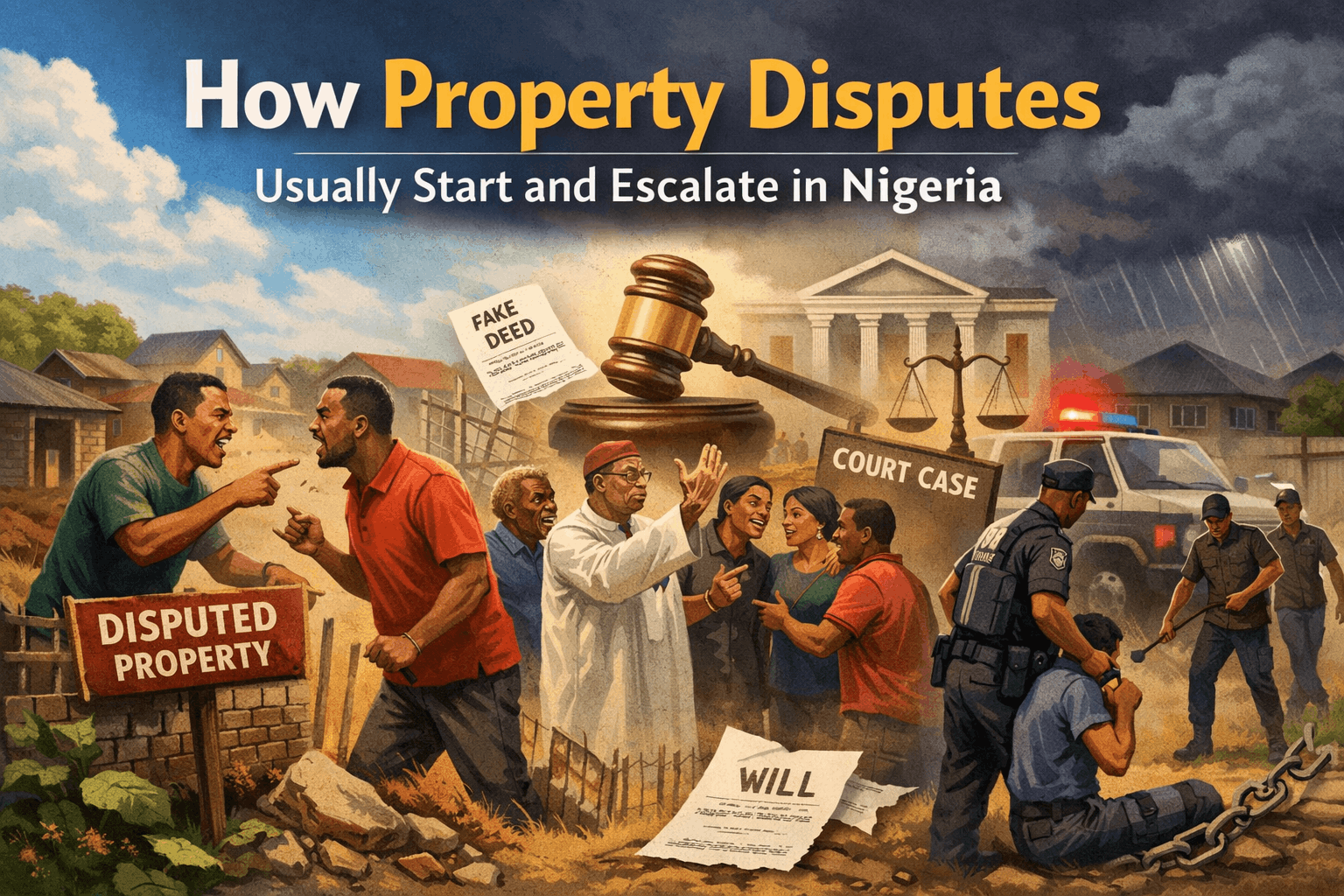
Property disputes are one of the most common legal and social conflicts in Nigeria. They often begin quietly, sometimes from simple misunderstandings, and then grow into long, expensive, and emotionally draining battles. Many of these disputes could have been avoided if the parties involved understood how they usually start and why they escalate.
This article explains, in clear terms, how property disputes typically begin in Nigeria, the common triggers, and how minor issues often grow into serious conflicts.
What Is a Property Dispute?
A property dispute is a disagreement between two or more parties over ownership, boundaries, usage, inheritance, or control of land or buildings. These disputes can involve individuals, families, communities, developers, or even government agencies.
In Nigeria, property disputes are common because land is highly valuable, documentation systems are sometimes unclear, and traditional practices still coexist with formal laws.
How Property Disputes Usually Start
Most property disputes do not start as court cases. They usually begin informally and gradually become serious. Below are the most common ways they start.
Lack of Clear Ownership Documents
One of the biggest causes of property disputes in Nigeria is unclear or incomplete documentation. This happens when land is bought without proper verification or when documents are missing, outdated, or poorly written.
Examples include:
-
Buying land with only a receipt and no survey
-
Relying on verbal agreements
-
Using documents that were never registered or perfected
When another person later presents a stronger document or claims ownership, a dispute begins.
Family and Inheritance Issues
Property disputes often start within families, especially after the death of a property owner. In many cases, the deceased did not leave a clear will, or the will is contested.
Common triggers include:
-
Disagreement among siblings over who owns what
-
Extended family members laying claim to land
-
Conflict between customary inheritance rules and written documents
What starts as a family discussion can quickly turn into a serious dispute when emotions and money become involved.
Boundary and Encroachment Problems
Boundary disputes are very common. They usually start when:
-
A neighbor builds beyond their boundary
-
A fence is erected without proper measurement
-
Survey plans overlap or are inaccurate
At first, it may be a simple complaint, but if one party refuses to adjust or acknowledge the issue, the situation escalates.
Multiple Sales of the Same Property
In some cases, property disputes start because the same land is sold to multiple buyers. This can happen due to:
-
Fraud by land sellers
-
Family members selling communal land without consent
-
Caretakers or agents selling land illegally
When two buyers show up claiming ownership, the dispute becomes inevitable.
Informal Agreements and Assumptions
Many property disputes begin because people rely on assumptions instead of clear agreements. For example:
-
Allowing a relative to stay on land without clear terms
-
Letting someone use property temporarily without written consent
-
Assuming long-term occupation equals ownership
Over time, these informal arrangements create expectations that later turn into disputes.
How Property Disputes Escalate
Once a dispute starts, it often escalates through predictable stages. Understanding these stages helps explain why small issues become major conflicts.
Refusal to Communicate
The first sign of escalation is usually a breakdown in communication. Instead of discussing the issue calmly, parties begin to avoid each other or communicate through threats and accusations.
At this stage:
-
Trust is lost
-
Positions become hardened
-
Compromise becomes difficult
Involvement of Third Parties
When direct communication fails, people involve third parties such as:
-
Family elders
-
Community leaders
-
Lawyers
-
Area boys or informal enforcers
While elders can sometimes help, involving the wrong third parties often makes things worse, especially when force or intimidation is used.
Physical Alterations and Harassment
As disputes escalate, some parties resort to:
-
Blocking access to the property
-
Harassing occupants
-
Destroying fences or structures
-
Physical confrontations
This stage marks a serious escalation and often leads to police involvement.
Police Reports and Arrests
Many property disputes enter the criminal system when one party reports the matter to the police. Although property disputes are largely civil matters, police involvement is common in Nigeria.
This stage often includes:
-
Statements and counter-statements
-
Arrests or threats of arrest
-
Pressure to settle under fear
Instead of resolving the issue, this often deepens the conflict.
Court Cases and Long Legal Battles
When disputes reach the courts, escalation becomes formal and prolonged. Court cases can last for years due to:
-
Adjournments
-
Multiple appeals
-
Conflicting documents and witnesses
By this stage, legal costs, stress, and bitterness are high, and relationships are often permanently damaged.
Why Property Disputes Are Hard to Resolve
Property disputes in Nigeria are difficult to resolve because:
-
Land records may be incomplete or inconsistent
-
Customary practices conflict with statutory law
-
Emotions and family ties complicate decisions
-
Multiple authorities may claim jurisdiction
These factors make resolution slow and complicated.
Common Mistakes That Make Disputes Worse
Many people unknowingly worsen property disputes by:
-
Acting emotionally instead of logically
-
Using threats or force
-
Ignoring documentation issues early
-
Refusing mediation or settlement
-
Delaying legal advice until the problem is severe
These mistakes push disputes toward escalation instead of resolution.
How Property Disputes Can Be Prevented
While not all disputes can be avoided, many can be prevented by:
-
Verifying ownership documents before buying
-
Conducting proper surveys
-
Registering and perfecting land documents
-
Using written agreements, even among family
-
Seeking legal advice early
Prevention is always cheaper and easier than resolution.
Final Thoughts
Property disputes in Nigeria rarely start as major conflicts. They usually begin with small issues such as unclear documents, family misunderstandings, or boundary problems. When ignored or handled poorly, these issues escalate through confrontation, third-party involvement, police actions, and long court cases.
Understanding how property disputes start and escalate helps individuals make better decisions, protect their interests, and avoid costly mistakes. Clear documentation, early communication, and proper guidance remain the best tools for preventing property conflicts in Nigeria.

 Daniel Okoye